
What Is Bitcoin and How Was It Created?
- Crypto9D
- February 19, 2026
In 2009 someone sent $50 worth of value across the internet with no bank, no fee, and no middleman. That moment changed finance forever. Here is exactly how it happened and why it still matters today.
Key Takeaways
What You Will Learn:
✅ Who created Bitcoin and why
✅ How Bitcoin transactions actually work
✅ Why Bitcoin has a fixed supply of 21 million
✅ How Bitcoin compares to gold
✅ How to buy Bitcoin safely in 2026
Bitcoin is the world’s first decentralized digital currency. It is money designed for the internet that operates without banks, governments, or financial intermediaries.
Since its launch in 2009, Bitcoin has grown from a niche experiment among cryptographers into a globally recognized financial asset held by individuals, corporations, and even governments.
21 Million
Maximum Bitcoin that will ever exist

The Origins of Bitcoin
2009
The year Bitcoin launched - 17 years ago
Bitcoin was created by individual or may be a group, using the name Satoshi Nakamoto. In October 2008, Nakamoto published a white paper titled “Bitcoin: A Peer-to-Peer Electronic Cash System.” The paper proposed a revolutionary idea: a way to send money over the internet directly between people without relying on a trusted third party such as a bank.
First Bitcoin mined, value essentially zero
First real purchase - 10,000 BTC for two pizzas
First major bull run, hits $20,000
All time high of $69,000
ETF approval by SEC
Strategic Bitcoin Reserve announced by US government
At the time, the global financial system was reeling from the 2008 financial crisis. Trust in banks and governments was low, and Bitcoin emerged as an alternative system built on transparency, cryptography, and mathematical rules rather than institutional authority.
Key Moment:
The Bitcoin network was formally launched on January 3, 2009, when Nakamoto mined the first block, referred to as the Genesis Block. Embedded in that block was a message referencing a newspaper headline about bank bailouts, widely interpreted as a critique of the traditional financial system.
What Is Bitcoin?
Bitcoin (BTC) is a decentralized digital currency that allows people to send value to one another over the internet securely and directly. Unlike traditional currencies such as the U.S. dollar or euro, Bitcoin:
Bitcoin transactions are recorded on a public ledger called the blockchain, which anyone can view and verify.
Bitcoin vs Gold
|
|
Bitcoin
|
Gold
|
|---|---|---|
|
Supply
|
21 million cap
|
Unknown, still being mined
|
|
Portability
|
Send anywhere in minutes
|
Heavy, hard to move
|
|
Divisibility
|
Down to 0.00000001
|
Hard to divide
|
|
Verification
|
Instant on blockchain
|
Requires testing
|
|
Storage
|
Digital wallet
|
Physical vault
|
How Bitcoin Works
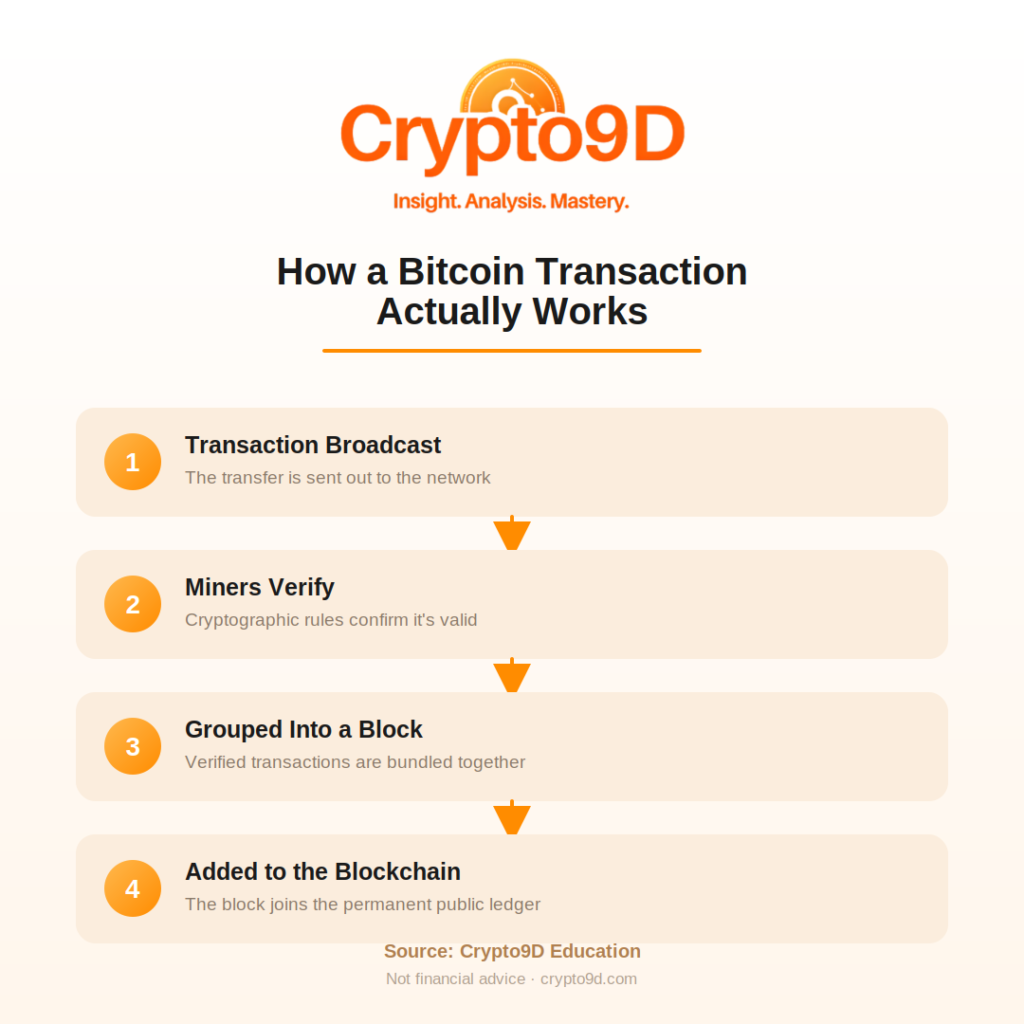
At the core of Bitcoin is the blockchain, a distributed ledger that records every transaction ever made. Instead of being stored on a single server, the blockchain is copied across thousands of computers worldwide, known as nodes.
When someone sends Bitcoin:
- The transaction is broadcast to the network
- Miners verify the transaction using cryptographic rules
- Verified transactions are grouped into a “block”
- The block is added permanently to the blockchain
This system prevents double-spending and fraud without requiring a central authority.
Mining and Supply Control
Bitcoin is created through a process called mining, where specialized computers compete to solve complex mathematical problems. The first miner to solve the problem earns newly created Bitcoin as a reward.
Bitcoin’s supply is intentionally limited. Approximately every four years, the reward for mining new blocks is cut in half in an event known as the halving. This mechanism reduces the rate at which new Bitcoin enters circulation and ensures that the total supply will never exceed 21 million.
2140
The year the last Bitcoin will be mined
This predictable scarcity is one reason Bitcoin is often compared to gold and referred to as “digital gold.
Ownership and Security
Bitcoin ownership is determined by private keys, which function like cryptographic passwords. Bitcoin is controlled by whoever has the private key. Transactions are secured using advanced cryptography, making the network extremely resistant to fraud and tampering. Importantly, Bitcoin transactions are:
- Irreversible
- Pseudonymous (addresses are visible, identities are not)
- Permissionless (anyone can participate)
Why Bitcoin Has Value
Bitcoin has value for many of the same reasons traditional money does—because people trust it and are willing to exchange it for goods, services, or other assets. Its key value drivers include:
- Scarcity (limited supply)
- Security (cryptographic protection)
- Portability (easy global transfer)
- Divisibility (can be split into tiny units called satoshis)
- Decentralization (no single point of control)
Over time, Bitcoin has evolved beyond a payment system into a store of value, an investment asset, and a financial hedge against inflation and currency debasement.
Bitcoin Today
Nowadays, most people agree that Bitcoin is the most significant cryptocurrency worldwide. It is traded on regulated exchanges, held by institutional investors, and accessible through financial products such as exchange-traded funds (ETFs). Major companies accept Bitcoin for payments, and some governments hold it as part of their reserves.
At the same time, Bitcoin remains controversial. Critics point to price volatility, environmental concerns related to mining, and regulatory uncertainty. Supporters argue that ongoing technological improvements, increased use of renewable energy, and clearer regulation are strengthening the ecosystem.
$1 Trillion+
Bitcoin's market cap as of 2026
The Legacy of Bitcoin
More than a decade after its creation, Bitcoin has never been hacked at the protocol level. Its code is open-source, its monetary policy is transparent, and its network continues to operate independently of any government or corporation.
Perhaps most remarkably, Satoshi Nakamoto disappeared in 2011, leaving Bitcoin fully in the hands of its global community. This absence reinforced Bitcoin’s core principle: a financial system that belongs to no one and is accessible to everyone.
Conclusion
Bitcoin is more than just digital money. It represents a fundamental shift in how value can be stored, transferred, and secured in the digital age. Created in response to a crisis of trust, Bitcoin introduced a new financial model based on mathematics, cryptography, and decentralization.
As technology, regulation, and adoption continue to evolve, Bitcoin’s role in the global economy remains one of the most important financial developments of the 21st century.
Check Out Our Related Services
Ready to apply what you've learned about Bitcoin? Crypto9D offers expert services to help you navigate the crypto world with confidence:
Crypto Analysis
Get comprehensive analysis – fundamental, quantitative, qualitative, and on-chain – to make informed investment decisions.
Tokenomics Design
Get comprehensive analysis – fundamental, quantitative, qualitative, and on-chain – to make informed investment decisions.
Regulatory Compliance
Navigate complex Web3 regulations and ensure your project operates legally across all jurisdictions.
Crypto Education
Master crypto concepts with bespoke training programs tailored to your experience level.
From Bitcoin's creation to today's market opportunities, knowledge is your strongest asset.
Crypto9D delivers insights, trends, and updates to help you navigate crypto with confidence.
These external websites also discuss the same topic:
- Coinbase – What is Bitcoin – Read more on Coinbase’s educational resources
- U.S. News – The History of Bitcoin – In-depth history and analysis from U.S. News
- Investopedia – Bitcoin Definition – Comprehensive Bitcoin definition from Investopedia
Related Articles:
Top 10 Promising AI, DePIN & RWA Projects – with High Growth Potential for 2026
Bybit Exchange Review 2026 – Institutional Power for Everyone
- Master the art of crypto scalping in 2026 – See how crypto scalping works
What Is Copy Trading? – How It Works
What Is Bitcoin and How Was It Created? – Bitcoin is the world’s first decentralized digital currency
What Are Crypto Wallets – How They Protect Your Funds
Liquidity in Crypto Trading – What It Means and Why It Matters
What Are ETFs – and How Are They Transforming the Way People Invest?
Top 5 Safest Crypto Exchanges – for Beginners:2026 Comprehensive Guide