
What Are ETFs and How Are They Transforming the Way People Invest?
- Crypto9D
- February 25, 2026
Not long ago, investing felt intimidating and exclusive. It was commonly associated with financial professionals, complex charts, and the assumption that meaningful returns required large amounts of capital. For everyday individuals, building a diversified investment portfolio often seemed out of reach.
That perception has steadily shifted, and exchange-traded funds—better known as ETFs—have played a central role in this change. More than a convenient investment product, ETFs have reshaped how people think about markets, risk, and long-term wealth creation.
Rather than encouraging constant trading or stock-by-stock speculation, ETFs promote a broader, more strategic approach to investing. They simplify access to markets while encouraging discipline, patience, and clarity. Understanding ETFs, therefore, is not just about learning a financial instrument—it’s about understanding a new investing mindset.
ETFs Explained: One Investment, Many Assets
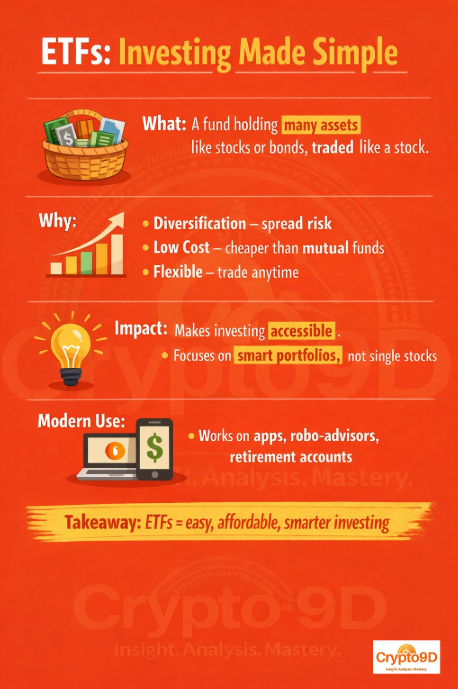
An ETF is a fund that holds a collection of assets, such as stocks, bonds, commodities, or currencies, and trades on an exchange in the same way a stock does. When an investor purchases an ETF share, they gain exposure to all the assets held inside the fund.
This structure allows investors to spread risk across multiple holdings with a single transaction. Instead of buying individual securities one by one, an ETF offers immediate diversification across sectors, industries, regions, or asset classes.
What makes ETFs especially appealing is their flexibility. Unlike traditional investment funds that are priced once per day, ETFs trade continuously during market hours. This gives investors transparency, liquidity, and control, while still benefiting from diversification.
A Shift Away From Stock Chasing
One of the most noticeable changes driven by ETFs is how investors approach decision-making.
Historically, investing culture revolved around identifying winning stocks. Many investors focused on timing the market, chasing trends, or trying to outperform benchmarks through frequent trades. While this approach can be exciting, it often increases risk and emotional stress.
ETFs encourage a different way of thinking. Instead of focusing on individual companies, investors are prompted to think in terms of markets, sectors, and long-term trends. The question shifts from “Which stock should I buy?” to “What part of the economy do I want exposure to?”
This broader perspective supports more thoughtful portfolio construction and reduces reliance on short-term predictions. Over time, it helps investors prioritize consistency over speculation.
Cost Efficiency Changes Investor Behavior
High costs have long been a silent obstacle in investing. Management fees, trading commissions, and minimum investment requirements can quietly erode returns, especially over long time horizons.
ETFs address this issue by operating with leaner structures. Many ETFs follow predefined indices rather than relying on active stock selection, which significantly lowers operating expenses. These savings are passed on to investors in the form of lower fees.
Beyond improving returns, lower costs influence investor psychology. When fees are minimal, investors feel less pressure to trade frequently or chase short-term gains. This supports a calmer, more deliberate investing approach—one focused on staying invested rather than reacting to every market fluctuation.
Transparency Encourages Confidence
Another defining feature of ETFs is clarity. Most ETFs disclose their holdings regularly, allowing investors to see exactly what assets the fund contains and how they are weighted.
This level of visibility contrasts with older investment products that often provided limited or delayed information. Knowing what you own fosters trust and reduces uncertainty.
When markets become volatile, transparent holdings help investors stay grounded. Rather than reacting emotionally to headlines, they can evaluate whether market movements align with their long-term objectives. Over time, this understanding strengthens confidence and supports better decision-making.
The Role of ETFs in Passive Investing
ETFs have become closely associated with passive investing, an approach built on the idea that markets are difficult to consistently outperform over time.
Instead of trying to predict winners, passive investors aim to capture overall market performance. ETFs make this strategy accessible by tracking indices that represent broad markets or specific segments of the economy.
This philosophy reshapes investor expectations:
- Participation replaces prediction
- Probability matters more than precision
- Consistency outweighs constant action
Passive investing does not mean disengagement. On the contrary, it requires intentional choices around asset allocation, diversification, and risk tolerance—factors that often have a greater impact on outcomes than short-term market timing.
Investing With Purpose: Themes and Values
Modern ETFs go far beyond traditional market indices. Today, investors can choose funds that focus on innovation, sustainability, or global challenges.
Instead of trying to predict winners, passive investors aim to capture overall market performance. ETFs make this strategy accessible by tracking indices that represent broad markets or specific segments of the economy.
These may include:
- Renewable energy and climate solutions
- Healthcare advancement
- Digital infrastructure and artificial intelligence
- Emerging economies
- Environmental, social, and governance (ESG) principles
This evolution allows investors to align their financial goals with personal values or long-term global trends. Instead of viewing investments as abstract numbers, many people now see their portfolios as reflections of what they believe in.
This alignment has attracted new participants to investing, particularly younger generations seeking both financial growth and positive impact.
Lowering the Barrier for New Investors
ETFs have become a gateway into investing for millions of people.
Their accessibility is driven by:
- Low entry costs
- Straightforward trading
- Built-in diversification
- Transparent fee structures
For beginners, ETFs reduce complexity and fear. Investors can start with broad market exposure and expand their knowledge gradually, without needing advanced financial expertise.
This ease of entry has reshaped how individuals emotionally relate to investing. Instead of viewing markets as risky or overwhelming, many now see them as long-term tools for financial stability and growth.
Global Markets Made Simple
ETFs also simplify access to international investing. With a single fund, investors can gain exposure to foreign markets, global industries, or emerging economies without managing multiple accounts or currencies.
This global reach encourages investors to think beyond local markets. It fosters awareness of worldwide economic trends, innovation cycles, and demographic shifts that influence long-term growth.
As a result, ETFs promote a mindset that reflects today’s interconnected global economy.
Redefining Risk
While ETFs do not remove risk, they help investors approach it more constructively.
By spreading exposure across many assets, ETFs reduce reliance on the performance of any single security. This diversification helps smooth volatility and limits the impact of isolated failures.
Over time, investors learn that market fluctuations are a natural part of investing—not signals to panic. This understanding builds emotional resilience and supports long-term discipline, even during uncertain periods.
ETFs and the Evolution of European Investing
Across Europe, ETFs are increasingly viewed as core portfolio components rather than niche products. Improved regulation, tax-efficient structures, and better market infrastructure are accelerating adoption among both retail and institutional investors.
As access continues to improve, ETFs are helping bridge gaps between markets and investor groups. This is fostering a more inclusive investment environment—one that empowers individuals to participate using the same tools as large institutions.
A Fundamental Change in Mindset
Ultimately, the impact of ETFs goes beyond mechanics.
They influence how often people trade, how they respond to volatility, and how they define success. The modern ETF-driven mindset emphasizes:
- Long-term engagement instead of short-term speculation
- Strategy over prediction
- Discipline over emotion
- Alignment over impulse
In this way, ETFs subtly guide behavior toward decisions that historically lead to stronger outcomes.
User Case:
Practical ETF Example
Instead, you buy one ETF like an S&P 500 ETF.
What happens?
- That single ETF automatically invests your money across 500 large U.S. companies
- If Apple or Microsoft grows, your ETF value increases
- If one company performs poorly, others help balance the risk
Real-life benefit:
With one purchase, you get diversification, lower risk, and lower cost—without actively managing multiple stocks.
Conclusion
Exchange-traded funds are more than a convenient investment option. They represent a shift in how people access, understand, and participate in financial markets.
By lowering costs, increasing transparency, and simplifying diversification, ETFs have empowered a broader audience to invest with confidence. They encourage patience, promote global thinking, and support sustainable investment habits.
As investing continues to evolve, ETFs are likely to remain at the heart of this transformation—not because they promise fast returns, but because they help investors think better, act smarter, and stay committed to long-term goals.
Ready to Learn More?
Stay informed on ETFs, crypto, and next-generation finance with Crypto9D.
Related Articles:
Top 10 Promising AI, DePIN & RWA Projects – with High Growth Potential for 2026
- Master the art of crypto scalping in 2026 – See how crypto scalping works
What Is Copy Trading? – How It Works