Top 5 Safest Crypto Exchanges for Beginners: 2026 Comprehensive Guide
- Crypto9D
- March 9, 2026

Cryptocurrency exchanges form the core infrastructure of the digital asset market. They are the platforms that make it possible for individuals and institutions to purchase, sell, convert, stake and manage digital currencies. What initially started as basic marketplaces for trading Bitcoin for traditional money has grown into advanced financial hubs offering professional trading tools, staking services, DeFi connectivity and even access to traditional financial products.
Modern exchanges aim to balance security, liquidity, compliance and usability. Each platform does, however, have unique advantages. Some prioritize simplicity for newcomers, others cater to high-volume traders, while a few emphasize regulatory clarity or decentralized access.
This guide provides a comprehensive, original overview of leading crypto exchanges and what differentiates them.
Key Takeaways
Understanding the Two Main Types of Exchanges
Before comparing platforms, it’s essential to understand the structural difference between centralized and decentralized exchanges.
Centralized Exchanges (CEX)
entralized exchanges function as intermediaries. They operate order books, match buyers with sellers, and typically hold customer funds unless users withdraw them. In many ways, they resemble traditional financial trading platforms, but they focus on digital assets.
Major examples include:
Benefits of Centralized Exchanges
- Straightforward interfaces designed for ease of use
- Deep liquidity and fast trade execution
- Support for bank transfers and card payments
- Customer service access
- Advanced trading options like margin and derivatives
Drawbacks of Centralized Exchanges
- Users do not control private keys unless assets are withdrawn
- Exchanges can be targeted by hackers
- Identity verification is usually mandatory
- Trading and withdrawal fees apply
Decentralized Exchanges (DEX)
Decentralized exchanges remove the middleman. Trades occur directly between users’ wallets through blockchain-based smart contracts. There is no central authority managing custody.
Popular decentralized platforms include:
Benefits of Decentralized Exchanges
- Users maintain control of their private keys
- Greater privacy and reduced censorship
- Access to newer or niche tokens
- Reduced reliance on centralized entities
Limitations of Decentralized Exchanges
- Steeper learning curve
- Limited fiat currency support
- Liquidity can vary by token
- No direct customer support
Although decentralized trading is growing, centralized exchanges still account for most global trading volume due to convenience and accessibility.

Leading Crypto Exchanges Explained
Let’s examine some of the most recognized crypto exchanges in greater detail.
1. Kraken – Security and Advanced Trading Tools
Established in 2011, Kraken is one of the longest-running exchanges in the industry. Over time, it has built a reputation for strong security standards and regulatory alignment.
What Sets Kraken Apart
Security Infrastructure
Kraken emphasizes fund protection through measures such as cold storage, internal access controls and regular proof-of-reserves verification. Its long operating history without a major customer fund breach contributes to its credibility.
Platform Options
Users can choose between a beginner-friendly interface and Kraken Pro, which includes professional charting tools, multiple order types, futures and margin trading.
Asset Variety
The platform supports hundreds of cryptocurrencies and trading pairs, making it attractive for diversified investors.
International Reach
Kraken serves clients in numerous countries and holds regulatory approvals across multiple jurisdictions.
Ideal For
- Investors who prioritize security
- Traders requiring advanced technical tools
- Users interested in staking and derivatives
2. Coinbase – Accessibility and Public Transparency
Coinbase has become one of the most recognizable names in cryptocurrency, particularly in the United States. Founded in 2012, it gained additional legitimacy by becoming a publicly traded company.
Key Advantages
Regulatory Transparency
As a public company, Coinbase publishes financial disclosures and operates under U.S. securities regulations. This transparency appeals to cautious investors.
User-Friendly Experience
Its primary app is designed for simplicity, making it approachable for beginners entering crypto for the first time.
Advanced Trading Option
Coinbase Advanced offers lower fees and more robust tools for experienced traders.
Security Measures
Features such as two-factor authentication and cold storage policies strengthen account protection.
Considerations
Transaction costs on the standard platform may be higher compared to competitors.
Ideal For
- New investors
- U.S.-based users seeking regulatory clarity
- Individuals valuing simplicity over complexity

3. Bybit – High Liquidity and Advanced Trading Features
Bybit is one of the fastest-growing exchanges, known for its excellent trading interface, high liquidity, and strong security measures.
Notable Features:
- Deep liquidity across spot and derivatives markets
- Clean and intuitive interface designed for both newcomers and seasoned traders.
- Competitive fees and fast execution
Advanced tools including futures, copy trading, and trading bots
Ideal For
- Active traders
- Users looking for good liquidity and low fees
- Beginners who want to explore derivatives trading safely
4. Crypto.com – Mobile Ecosystem and Consumer Features
Launched in 2016, Crypto.com has expanded beyond trading into a broader digital asset ecosystem.
Highlights
Mobile-Centric Platform
The app is designed for seamless trading on smartphones, appealing to modern retail users.
Ecosystem Integration
Services include spot trading, derivatives, staking, NFTs and crypto-backed debit cards.
Brand Visibility
Strategic sponsorships and partnerships have significantly increased global brand recognition.
Considerations
Fee structures can vary depending on trading activity and token holdings.
Ideal For
- Users who prefer managing assets via mobile
- Individuals interested in crypto rewards cards
- Investors exploring broader ecosystem services
5. Binance – Scale and Market Depth
Binance quickly became the largest crypto exchange by trading volume after launching in 2017.
Notable Features
- Extensive selection of trading pairs
- Deep liquidity across markets
- Futures and derivatives trading
- Token launch platform for new projects
Considerations
Regulatory developments in different regions can affect availability.
Ideal For
- Active and high-volume traders
- Altcoin enthusiasts
- Users seeking high liquidity

Comparing Centralized and Decentralized Models
|
Feature
|
Centralized Exchanges
|
Decentralized Exchanges
|
|---|---|---|
|
Asset Custody
|
Held by exchange
|
Controlled by user
|
|
Identity Verification
|
Typically required
|
Often optional
|
|
Ease of Access
|
Simple onboarding
|
Technical setup required
|
|
Liquidity
|
Generally high
|
Token-dependent
|
|
Fiat Integration
|
Common
|
Rare
|
Centralized exchanges remain dominant because they simplify entry into crypto markets. Decentralized platforms, however, continue to attract users who value autonomy and censorship resistance.
Selecting the Right Exchange
Choosing an exchange depends on individual goals and risk tolerance.
- New to crypto? A user-friendly platform like Coinbase or Kraken may be suitable.
- Need advanced analytics and derivatives? Kraken Pro , Bybitor Binance could fit.
- Want ecosystem features and rewards? Crypto.com offers integrated services.
- Value privacy and self-custody? A DEX like Uniswap may be worth exploring.
Many experienced investors diversify across multiple platforms to reduce operational risk and access different features.

User Case:
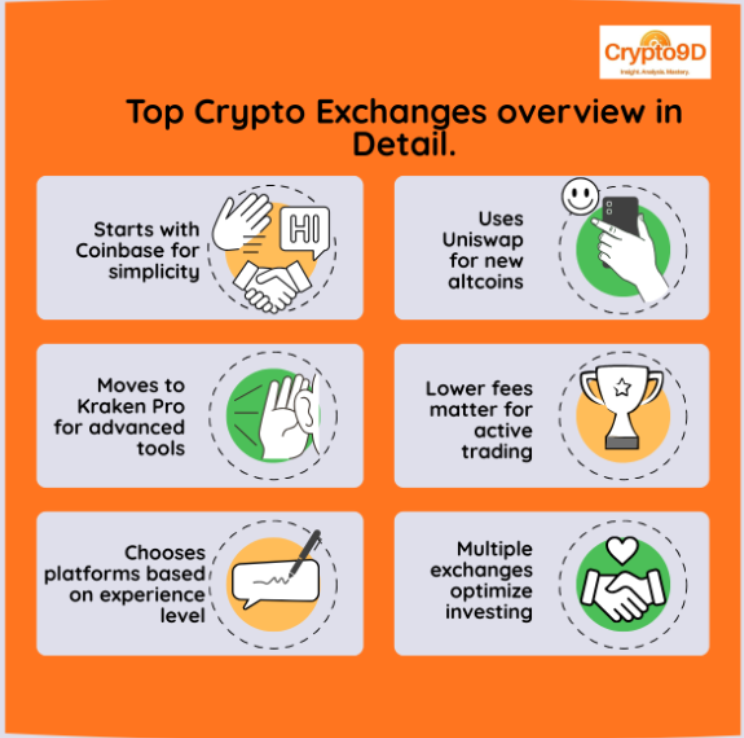
Ali wants to start investing in crypto. After reading the “Top Crypto Exchange Overview in Detail”, he compares platforms based on his needs.
Since he’s a beginner, he chooses Coinbase for its simple interface to buy his first Bitcoin.
Later, when he becomes more confident and wants lower fees and advanced charts, he opens an account on Kraken to use Kraken Pro.
For buying a newly launched altcoin not listed on major exchanges, he connects his wallet to Uniswap.
This shows how understanding different exchanges helps investors choose the right platform at each stage of their crypto journey.
Conclusion
Crypto exchanges have matured significantly over the past decade. What once served as simple marketplaces have transformed into multifaceted financial platforms supporting millions of users worldwide.
Whether using Kraken, Coinbase, Bybit, Crypto.com or Binance, the key is aligning platform features with personal objectives.
Security practices, fee structures, asset availability and regulatory positioning should all factor into the decision-making process. As the industry continues to evolve, informed decision-making remains one of the most valuable tools an investor can have.
Check Out Our Related Services
Ready to apply what you've learned about Bitcoin? Crypto9D offers expert services to help you navigate the crypto world with confidence:
Crypto Analysis
Get comprehensive analysis – fundamental, quantitative, qualitative, and on-chain – to make informed investment decisions.
Tokenomics Design
Get comprehensive analysis – fundamental, quantitative, qualitative, and on-chain – to make informed investment decisions.
Regulatory Compliance
Navigate complex Web3 regulations and ensure your project operates legally across all jurisdictions.
Crypto Education
Master crypto concepts with bespoke training programs tailored to your experience level.
Want deeper crypto insights that actually matter?
Join Crypto9D and stay informed, prepared, and ahead of the market.
Related Articles:
Top 10 Promising AI, DePIN & RWA Projects – with High Growth Potential for 2026
- Master the art of crypto scalping in 2026 – See how crypto scalping works
What Is Copy Trading? – How It Works
What Is Bitcoin and How Was It Created? – Bitcoin is the world’s first decentralized digital currency
What Are Crypto Wallets – How They Protect Your Funds
Liquidity in Crypto Trading – What It Means and Why It Matters
What Are ETFs – and How Are They Transforming the Way People Invest?