
5 AI-Powered Crypto Projects Poised to Beat the Market This Year
- Crypto9D
- June 30, 2026
Artificial intelligence has crossed a critical threshold. By 2026, it is no longer a novel feature layered onto crypto products and it has become a foundational force shaping how decentralized markets function. AI systems now analyze data continuously, execute trades autonomously, manage liquidity, coordinate agents, and interact directly with smart contracts.
As this shift accelerates, one reality has become clear: not all “AI crypto” projects are created equal. While hundreds of tokens market themselves as AI-driven, only a small number are embedded deeply enough into real infrastructure to capture lasting value.
This article focuses on five AI-powered crypto projects that are structurally positioned to outperform the broader market this year. These projects are not winning because of hype or short-term narratives, but because they operate at choke points where AI demand, decentralized infrastructure, and economic incentives intersect.
AI and Crypto: Why the Market Is Maturing
The early AI-crypto boom was fueled largely by storytelling. Tokens rallied on announcements, vague partnerships, or speculative claims of AI integration. That phase is fading fast.
In today’s market, investors and developers are prioritizing execution over excitement. Capital is flowing toward projects that solve tangible problems AI systems face in decentralized environments, such as:
- Producing high-quality intelligence without centralized ownership
- Accessing scalable and affordable compute resources
- Coordinating autonomous agents across networks
- Verifying execution and outcomes in trust-minimized ways
- Making complex systems usable for non-experts
Protocols that address these constraints are becoming infrastructure dependencies rather than optional tools. Historically, in both traditional tech and crypto, infrastructure layers tend to outperform application-level speculation over time.
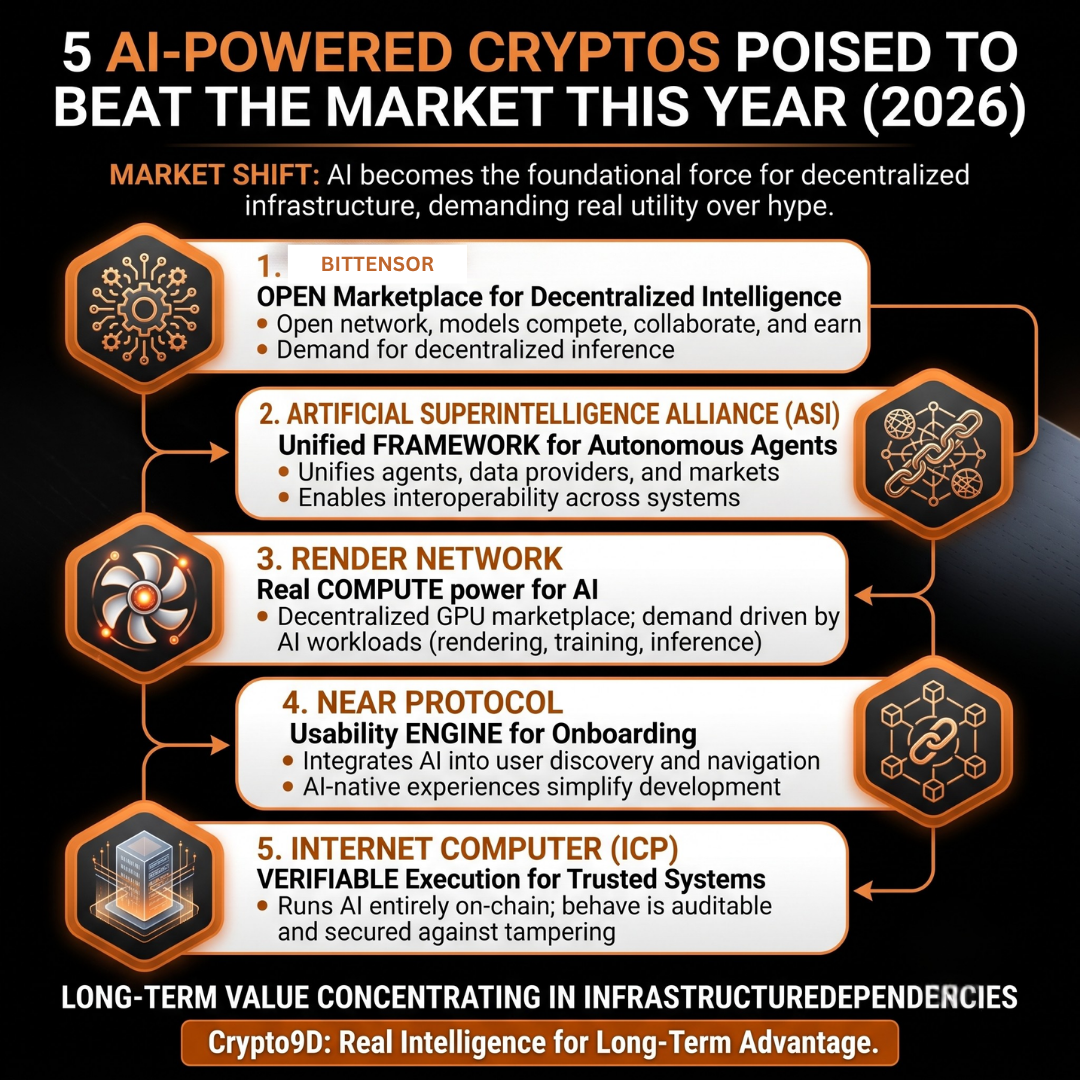
1. Bittensor: Turning Intelligence Into an Open Economy
Bittensor approaches AI from a radically different angle. Instead of concentrating intelligence inside a single organization or model, it creates an open marketplace where AI systems compete, collaborate, and earn based on performance.
Independent models operate in specialized subnets—each focused on a specific task such as language understanding, prediction, ranking, or data filtering. Their outputs are constantly evaluated, and rewards flow toward models that deliver the most useful results.
Why Bittensor Is Structurally Strong
Most AI platforms today are opaque. Users contribute data and usage, but ownership and economic upside remain centralized. Bittensor inverts that dynamic by allowing contributors to retain control while competing in an open environment.
This design creates two powerful tailwinds:
- Growing demand for decentralized inference as developers seek alternatives to closed APIs
- Direct token utility, where participation, security, and governance are tied to real usage
Rather than betting on a single dominant model, Bittensor monetizes the entire intelligence layer. As specialized AI services become more valuable than general-purpose models, this approach becomes increasingly resilient.
2. Artificial Superintelligence Alliance: Coordinating Autonomous Systems
Decentralized AI does not fail because of a lack of models but it fails because of fragmentation. The Artificial Superintelligence Alliance (ASI) is designed specifically to address this problem.
Instead of focusing on one protocol or product, ASI acts as a coordination framework that unifies agents, data providers, compute resources, and marketplaces into a single economic system.
Why Coordination Is the Real Edge
As AI agents begin to act independently so trading, allocating capital, negotiating services, the ability to coordinate across chains and platforms becomes critical.
ASI enables:
- Specialized agents that interoperate instead of competing in silos
- Data marketplaces where contributors retain ownership
- Modular AI services that developers can compose rather than rebuild
This positions ASI as a meta-layer for decentralized intelligence. As agent-based economies expand, coordination layers are likely to capture increasing value relative to standalone protocols.
3. Render Network: Powering AI With Real Compute
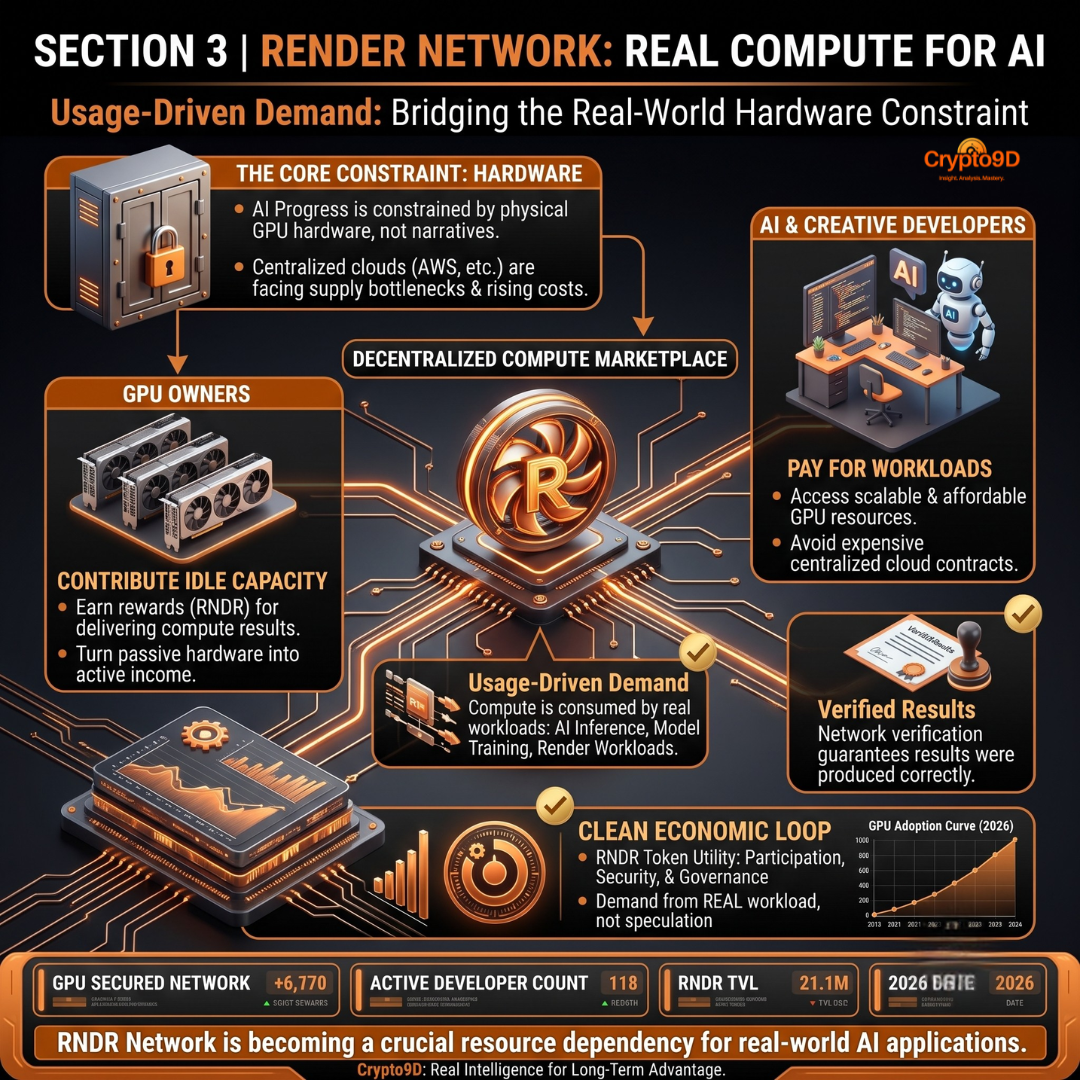
AI progress is ultimately constrained by hardware. Models do not run on narratives—they run on GPUs.
Render Network directly addresses this reality by creating a decentralized marketplace for computers. GPU owners contribute idle capacity, while creators and developers pay for rendering, training, and inference workloads.
Originally built for digital rendering, the network has evolved into a critical resource for AI applications.
Why Render’s Economics Matter
Unlike many AI tokens, Render’s demand is usage-driven. Compute is consumed by real workloads tied to revenue-generating activities across media, gaming, and AI development.
This creates a clean economic loop:
- Users pay for verified compute
- Providers earn for delivering results
- Token demand scales with AI adoption, not speculation
As centralized cloud providers face rising costs and supply constraints, decentralized computer markets are becoming a strategic alternative. Render sits squarely in that demand path.
4. NEAR Protocol: AI as a Usability Engine
Not every AI advantage appears at the model or hardware level. Sometimes, the biggest gains come from making systems easier to use.
NEAR Protocol is not an AI network by design but it is an AI-enabled blockchain. Its strategy focuses on integrating AI into onboarding, development, and user interaction to reduce friction across Web3.
Why Usability Is Underrated Alpha
As AI-driven applications grow more complex, the blockchains that succeed will be those that abstract complexity rather than expose it.
NEAR’s ecosystem emphasizes:
- AI-assisted development workflows
- Intelligent discovery and navigation tools
- Infrastructure designed for agent-to-agent interaction
As AI agents increasingly act on behalf of users, seamless execution becomes a competitive advantage. NEAR benefits indirectly from AI growth by positioning itself as a chain where AI-native experiences actually work at scale.
5. Internet Computer: Making AI Execution Verifiable
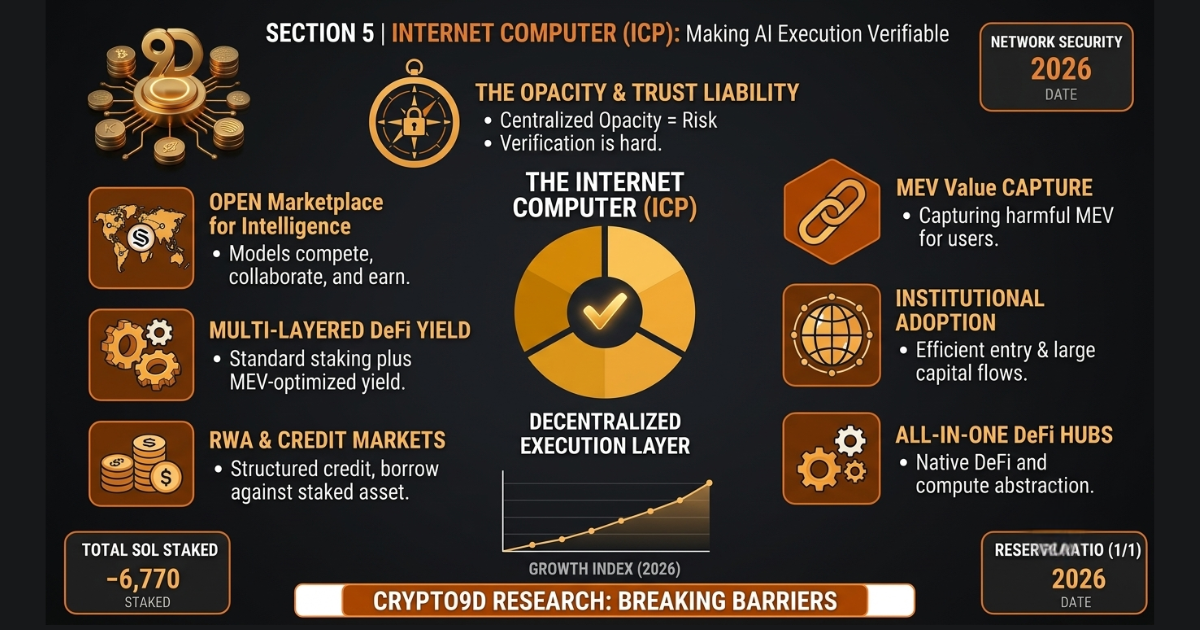
As AI systems influence financial decisions, governance, and public infrastructure, trust becomes non-negotiable.
Internet Computers push decentralization further than most platforms by enabling applications, including AI services to run entirely on-chain. Storage, computation, and execution are all verifiable without relying on traditional servers.
Why Verifiable AI Will Matter More
Opacity is increasingly a liability. ICP allows developers to deploy AI applications whose behavior can be audited, verified, and secured against tampering.
This architecture is particularly relevant for:
- Financial and compliance-sensitive systems
- Governance and public infrastructure
- Applications requiring censorship resistance
While adoption has been slower due to technical complexity, history shows that infrastructure built ahead of demand often captures value once trust requirements rise.
The Common Thread Across All Five
These projects differ in design and scope, but they share essential characteristics:
- Real, observable usage
- Tokens linked to functional demand
- Clear roles within the AI stack
- Infrastructure relevance that compounds over time
They are not competing narratives, they are complementary layers reflecting how modern AI systems are actually deployed.
User Case
Practical Example: AI-Powered Crypto Projects Beating the Market
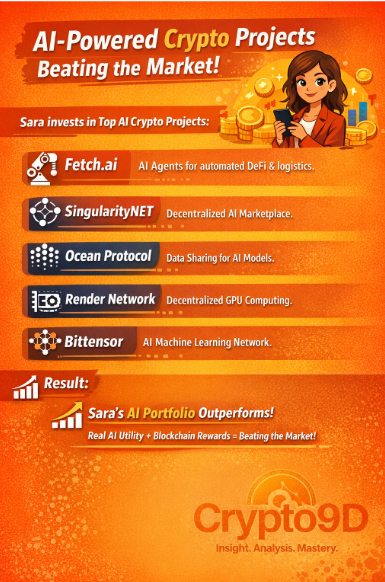
Imagine an investor, Sara, building a small crypto portfolio focused on AI-driven projects instead of hype coins.
- She invests in Fetch.ai, which uses AI agents to automate DeFi trading and logistics. As AI adoption grows, demand for its token rises.
- She adds SingularityNET, where developers sell AI services on-chain. Increased usage leads to higher network value.
- She includes Ocean Protocol, allowing AI models to access paid datasets—fueling both AI growth and token utility.
- For AI compute power, she invests in Render Network, which benefits from rising demand for AI and 3D processing.
- Finally, she allocates funds to Bittensor, rewarding developers who contribute useful AI models.
Result:
While the broader crypto market grows slowly, Sara’s AI-focused portfolio outperforms because these projects combine real AI utility with blockchain incentives, attracting users, developers, and long-term investors.
This content is published for educational purpose only and its not a financial advice. see our disclaimer page for more details on our policy.
Conclusion: Infrastructure Beats Narrative
Markets eventually reward what works.
In 2026, AI will no longer be an experimental add-on to crypto. It is embedded into economic activity itself. Projects that enable AI to operate transparently, efficiently, and at scale are becoming foundational infrastructure.
Bittensor monetizes intelligence.
ASI coordinates autonomous agents.
Render supplies compute.
NEAR simplifies interaction.
Internet Computers guarantee execution.
Together, they illustrate where long-term value is concentrating—not in hype cycles, but in the infrastructure that decentralized AI depends on to function.
This is the type of structural research we publish at scale.
Crypto9D delivers AI-driven crypto intelligence focused on infrastructure, execution, and long-term market advantage, beyond short-term narratives.
Related Articles:
Top 10 Promising AI, DePIN & RWA Projects – with High Growth Potential for 2026
Bybit Exchange Review 2026 – Institutional Power for Everyone
- Master the art of crypto scalping in 2026 – See how crypto scalping works
What Is Copy Trading? – How It Works
What Is Bitcoin and How Was It Created? – Bitcoin is the world’s first decentralized digital currency
What Are Crypto Wallets – How They Protect Your Funds
Liquidity in Crypto Trading – What It Means and Why It Matters
What Are ETFs – and How Are They Transforming the Way People Invest?
Top 5 Safest Crypto Exchanges – for Beginners:2026 Comprehensive Guide