
Master Web3 Onboarding in 2026 – The Ultimate Guide to Designing for Non-Crypto Natives
- Crypto9D
- May 30, 2026
Introduction: Why Onboarding Still Breaks Web3 Products
By 2026 Web3 technology has come a way, from its early days. Faster networks and better tools have made it possible for more industries to use systems. There’s still one big problem: getting regular people to use Web3 products. The issue is not that Web3 technology can’t do the job. It’s that people find it hard to use and don’t fully trust Web3 systems. Usability and trust are the things holding Web3 products back from reaching everyday users.
For those who do not know about blockchain systems, things like wallets, transaction signatures and actions that can not be undone can be confusing.This confusion can quickly turn into doubt. Doubt often makes people give up. This is why getting users started with a product, which we call onboarding, can not be treated as an afterthought.In Web3 onboarding is the starting point for everything. If users do not feel confident when they start using a product they will never get to experience the benefits it offers.
This guide is about designing an onboarding process that feels easy, safe and clear for people who have never used crypto systems before.It focuses on how to make onboarding experiences that’re intuitive, safe and understandable for people with no prior exposure to crypto systems.
1. Redefining Onboarding as a Trust-Building Process
When we talk about onboarding in the way it is basically making an account and figuring out how to use the basic things. With Web3 it is a whole different story. We have to help people understand a new way of doing things.
New users have to get used to some ideas like:
- Owning things directly without needing an account to hold them for us
- Saying yes to things by using codes instead of just using a password
- Knowing that some things we do cannot be undone
- Working with systems that’re open and honest but might seem weird at first
Because of all this, onboarding is not just about getting started it is about making people feel comfortable and sure of themselves. Each step should make people feel less unsure and more like they understand what is going on.A simple thing to remember when we are doing this is: Web3 onboarding is really about helping people understand Web3 and feel good about using it.
If users don’t understand what they are approving, they won’t trust your product.
2. Where New Users Struggle Most
To improve onboarding, you first need to understand the common points of friction.
Wallet Complexity
Wallets are often the first barrier. Terms like “seed phrase” and “private key” are unfamiliar, and the responsibility they place on users can feel overwhelming.
Fear of Transactions
Users worry about making irreversible mistakes. Sending assets to the wrong address or approving the wrong action feels risky, especially without safety nets.
Unclear Fees
Transaction costs can vary and are not always predictable. When users don’t understand why they are paying or how much it will cost, they hesitate.
Irreversible Actions
Unlike traditional apps, many blockchain actions cannot be undone. This raises the perceived risk of every interaction.
Delays and Confirmation Times
Waiting for transactions to confirm can make the system feel slow or unreliable, even when everything is working as intended.
3. Designing the User Experience Layer
The user interface and wallet interaction together form the most critical part of onboarding.
Make Actions Easy to Understand
Instead of exposing technical details, explain actions in plain language. Users should always know:
- What they are doing
- Why they are doing it
- What will happen next
Clear explanations reduce hesitation and build confidence.
Create Predictable User Flows
Users should never feel lost during a process. Define clear states such as:
- Waiting for user confirmation
- Processing transaction
- Completed successfully
- Failed with explanation
Predictability helps users stay oriented and reduces anxiety.
Integrate Wallet Interactions Smoothly
Wallet prompts should feel like a natural part of your product, not a disruptive external step.
You can improve this by:
- Explaining requests before they appear
- Reducing unnecessary approvals
- Grouping related actions when possible
Introduce Complexity Gradually
Avoid overwhelming users with technical concepts upfront. Start simple and introduce deeper functionality only when it becomes relevant.
4. Simplifying Without Losing Transparency
One of the biggest design challenges is simplifying the experience without hiding important details.
If you hide too much:
- Users lose visibility into what’s happening
- Trust decreases when something goes wrong
If you expose too much:
- Users feel overwhelmed and confused
The goal is to simplify explanations while still making outcomes clear. Users should always understand the consequences of their actions, even if they don’t see every technical detail.
5. Choosing the Right Wallet Approach
Your onboarding experience depends heavily on how users access their wallets.
Non-Custodial Options
These give users full control over their assets but require more responsibility and understanding.
Custodial Options
These simplify onboarding by managing keys on behalf of users, but they introduce reliance on your platform.
Hybrid Models
A growing approach combines ease of use with gradual user control. Users can start with a simplified experience and move toward full ownership over time.
This balance often works best for new audiences.
6. Designing Clear Transaction Experiences
Transactions are central to Web3, so they must be easy to understand.
Before the Transaction
Explain:
- What action is being performed
- What assets are involved
- Any associated costs
During the Transaction
Provide real-time updates so users know what is happening.
After the Transaction
Confirm the outcome clearly and provide next steps if needed.
Handling Errors
When something goes wrong:
- Use simple language
- Explain the issue
- Offer guidance on what to do next
Avoid technical jargon whenever possible.
7. Making Costs Understandable
Fees can be a major source of confusion.
Be Transparent
Always show:
- Estimated cost
- Currency equivalents
- Reason for the fee
Reduce Costs Where Possible
You can optimize experiences by:
- Combining actions
- Using more efficient networks
- Minimizing unnecessary interactions
Consider Covering Fees
In some cases, platforms can absorb transaction costs to simplify onboarding. If you do this, clearly explain how it works so users don’t become confused later.
8. The Role of Backend Systems
Even though users don’t see it, backend infrastructure plays a key role in onboarding.
It helps:
- Validate actions before they reach the blockchain
- Prevent abuse
- Improve performance through caching
- Handle retries and failures
A well-designed backend makes the entire experience smoother and more reliable.
9. Smart Contracts as User-Facing Components
Smart contracts should be treated as public interfaces, not just internal logic.
Keep Them Focused
Each contract should handle a specific responsibility to reduce complexity.
Design Clear Outputs
Events and logs should be structured so they can be easily interpreted and tracked.
Prepare for Updates
Changes should be planned and tested in advance. Users should not feel disrupted when improvements are made.
10. Making Blockchain Data Usable
Raw blockchain data is not easy to work with in real time.
To improve usability:
- Build indexing systems
- Store processed data for quick access
- Ensure consistency between views
This enables fast, reliable user experiences.
11. Handling Delays and Finality
Blockchain systems do not always provide instant results.
To manage expectations:
- Show immediate feedback after actions
- Clearly label pending states
- Confirm when actions are final
This helps users stay informed and reduces frustration.
12. Building Trust Through Clarity
Trust grows when users feel informed and in control.
Provide:
- Clear activity history
- Easy-to-read asset balances
- Transparent records of actions
When users can see and understand what’s happening, they are more likely to stay engaged.
13. Communicating Security Effectively
Security is essential, but it should not intimidate users.
Instead of overwhelming them:
- Offer simple guidance
- Highlight best practices
- Provide warnings only when necessary
The goal is to empower users, not scare them.
14. Strengthening Internal Workflows
Reliable onboarding depends on strong internal processes.
Teams should focus on:
- Consistent development environments
- Automated testing
- Clear documentation
These practices reduce errors and improve product stability.
15. Testing for Understanding, Not Just Functionality
A working system is not enough if users don’t understand it.
Test whether users:
- Know what actions they are taking
- Feel confident completing tasks
- Can continue without assistance
User feedback is critical for improving onboarding.
16. Measuring What Matters
Focus on metrics that reflect real user success:
- Completion of first meaningful action
- Time taken to reach that action
- Drop-off points during onboarding
- Return usage after initial interaction
These insights help refine the experience.
17. Avoiding Common Pitfalls
Some mistakes repeatedly slow down Web3 products:
- Treating decentralization as an add-on instead of a core system
- Making architectural decisions before defining trust boundaries
- Ignoring how systems fail and how users recover
- Presenting too much information too early
Avoiding these issues can significantly improve onboarding outcomes.
18. What’s Next for Web3 Onboarding
Onboarding is evolving toward:
- More seamless wallet experiences
- Simplified transaction flows
- Better abstraction of complexity
- Improved cross-network compatibility
However, the core challenge remains unchanged: helping users feel confident and in control.
Latest Happenings in Master Web3
To enhance your guide with the most current developments, here are four critical news updates from April 2026 that highlight the shift toward “invisible” onboarding for non-crypto natives:
1. The Rise of “Invisible Tech” in Global Onboarding
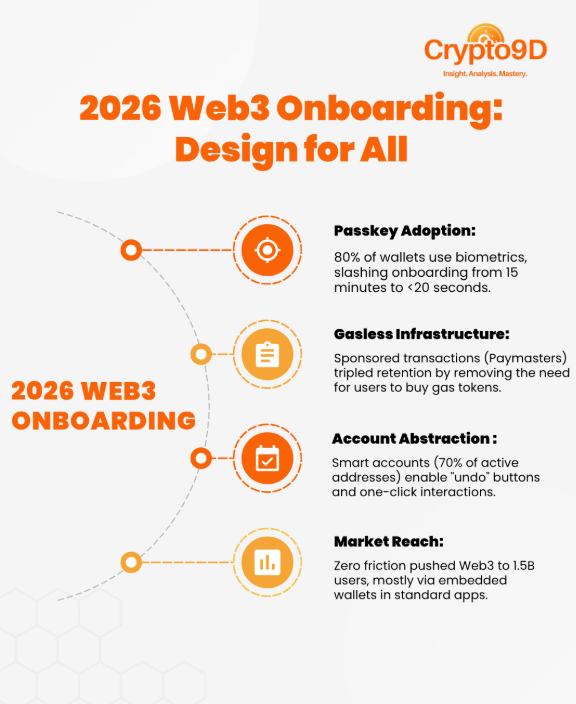
As of February 2026, the industry has officially moved into the “Invisible Tech” era. Major platforms are now replacing the traditional 24-word seed phrase with social logins (Google, Apple ID) and biometric authentication. This “walletless onboarding” allows users to interact with dApps immediately, generating a non-custodial wallet in the background without requiring a third-party browser extension.
2. Industry Leaders Call Out the “UX Gap”
In a recent address (April 20, 2026), Binance leadership highlighted that while over 600 million people have crypto exposure, only about 5% actively use dApps. The primary culprit remains the “UX Gap”—specifically the friction caused by manually choosing networks and managing gas fees. This reinforces the need for Chain Abstraction as a standard rather than a luxury.
3. Account Abstraction (EIP-4337) Becomes the Standard
By mid-2026, Account Abstraction has moved from a developer concept to the industry standard. New “Smart Contract Wallets” now support social recovery, allowing users to recover access through trusted friends rather than paper backups and “Paymasters,” which allow users to pay transaction fees in stablecoins or even have them sponsored by the application.
4. Zero-Knowledge Proofs for “Privacy-First” Onboarding
Recent live deployments in April 2026 show Zero-Knowledge Proofs (ZKPs) being used to streamline KYC and onboarding. For example, governments and financial institutions are piloting ZKP-based mechanisms that allow users to verify their identity or age without revealing sensitive underlying data, drastically reducing the “trust friction” for non-crypto natives entering the space.
User Case:
To understand how to master Web3 onboarding for non-crypto natives in 2026, let’s look at a practical example: “EcoTrack,” a fictional decentralized rewards app for sustainable shopping.
In 2026, the “Ultimate Guide” approach moves away from technical jargon (seed phrases, gas fees, RPC nodes) and focuses on Intent-Centric Design.
01
The "Invisible" Wallet Creation
Old Way (2021): User downloads Metamask, writes down 12 words, confirms them, and then starts the app.
2026 Practical Example: When a user opens EcoTrack, they sign up using Passkeys (FaceID or TouchID). Behind the scenes, an Account Abstraction (ERC-4337) wallet is created. The user never sees a private key; their “account” is tied to their biometric identity or a social login (Google/Apple).
02
Gasless Transactions (Paymasters)
Old Way (2021): User tries to claim a reward but fails because they don’t have $0.05 worth of ETH for “gas.” They must go to an exchange, KYC, buy ETH, and send it to their wallet.
2026 Practical Example:
EcoTrack uses a Paymaster. When the user clicks “Claim Reward,” the transaction is free for them. The app developer (EcoTrack) sponsors the gas fees to ensure a smooth UX, or the user pays the fee using the reward token itself rather than the native network token.
03
Progressive Onboarding (The "Hook First" Method)
Old Way (2021): Users must “Connect Wallet” before they can even see what the app does.
2026 Practical Example:
EcoTrack lets the user browse stores and “earn” points immediately. The points are stored in a local “shadow” account. Only when the user wants to trade those points for a high-value NFT or a real-world discount do they perform the 2-second “biometric secure” step to officially claim their on-chain identity.
04
Human-Readable Transactions
Old Way (2021): User signs a hex string like 0x4a2…f31 and hopes they aren’t being drained.
2026 Practical Example:
The wallet interface translates the smart contract interaction into plain English. Instead of “Sign Message,” the user sees:
“You are swapping 100 EcoPoints for a $10 Starbucks Coupon. Valid until Dec 2026.”
05
Multi-Device Recovery (No Seed Phrases)
Old Way (2021): If the user loses their paper backup, their money is gone forever.
2026 Practical Example:
EcoTrack utilizes Social Recovery. If the user loses their phone, they can recover their account by having two “Guardians” (a trusted friend’s wallet and the EcoTrack recovery service) approve a new device.
Summary of the 2026 Web3 Experience:
|
Feature
|
2021 Experience (Tech-First)
|
2026 Experience (User-First)
|
|---|---|---|
|
Login
|
Seed Phrase / Extension
|
Biometrics / Passkeys
|
|
Fees
|
Buy ETH/SOL first
|
Sponsored / Pay in any token
|
|
Security
|
"Don't lose your keys"
|
Social Recovery / Guardians
|
|
Language
|
Swap, Mint, Bridge
|
Earn, Buy, Transfer
|
By following this guide, EcoTrack achieves a 90% conversion rate because the user doesn’t even realize they are using a blockchain; they just know they are using a secure, fast, and rewarding app.
Conclusion: Turning Complexity Into Confidence
Web3 brings powerful things but they can be complicated. The goal of onboarding is to make that complexity easy for users to understand and feel safe with.
When onboarding is done carefully:
- Users feel taking action
- They know what they are doing
- They will probably come back
- Good Web3 products aren’t about the tech but also about helping users use it.
- Think of onboarding as a system, not just a step- by-step process. This way you create experiences that people can really use.
crypto9D is focused on turning complex blockchain interactions into seamless user experiences. Whether you’re launching a new dApp or improving an existing product, the difference between growth and drop-off comes down to how easily users can get started.
Closing Note
The transition to a seamless Web3 ecosystem in 2026 relies on a fundamental shift from technical education to intuitive design. To truly onboard the next wave of non-crypto natives, the underlying complexity of the blockchain must become invisible, mirroring the evolution of the early internet where users eventually stopped needing to understand TCP/IP to send an email. Closing this gap requires a commitment to “invisible” infrastructure—implementing social logins to replace seed phrases, automating gas fees through paymasters, and utilizing chain abstraction so that the end user never has to worry about which network they are on. Ultimately, the success of a platform will be measured by its ability to deliver the tangible benefits of decentralized ownership and security without the traditional technical friction, transforming Web3 from a niche enthusiast space into a professionalized, global standard for digital interaction.
Related Articles:
Top 10 Promising AI, DePIN & RWA Projects – with High Growth Potential for 2026
- Master the art of crypto scalping in 2026 – See how crypto scalping works
What Is Copy Trading? – How It Works
What Is Bitcoin and How Was It Created? – Bitcoin is the world’s first decentralized digital currency
What Are Crypto Wallets – How They Protect Your Funds
Liquidity in Crypto Trading – What It Means and Why It Matters
What Are ETFs – and How Are They Transforming the Way People Invest?
Top 5 Safest Crypto Exchanges – for Beginners:2026 Comprehensive Guide