
GENIUS Act and Its Impact on Digital Assets
- Crypto9D
- July 3, 2026

The passage of the GENIUS Act 2025, short for the Guiding and Establishing National Innovation for U.S. Stablecoins Act and marks a defining moment in the evolution of digital asset regulation in the United States. Signed into law in July 2025, the Act represents the first comprehensive payment stablecoin framework at the federal level. While its scope is technically focused on stablecoins, its implications extend far beyond a single asset class, reshaping the future of U.S. digital asset regulation, institutional crypto adoption, and decentralized finance (DeFi).
For years, the U.S. crypto market operated under regulatory ambiguity. Stablecoins sat in a gray zone and were sometimes treated like securities, sometimes like commodities, and often like something entirely new. The GENIUS Act changes that dynamic by clearly defining what payment stablecoins are, how they should be issued, and who has the authority to oversee them.
A New Regulatory Foundation for Stablecoins
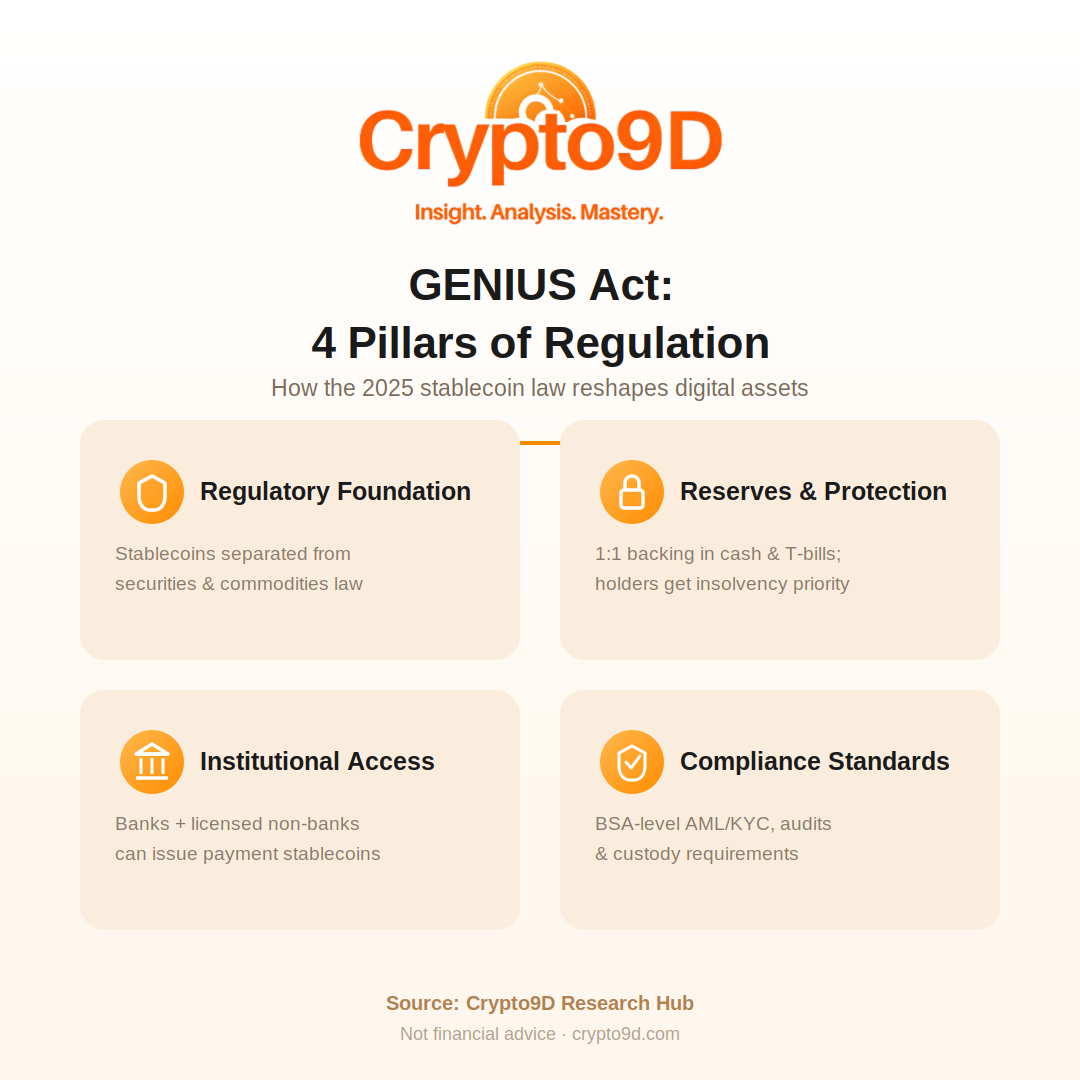
At the core of the GENIUS Act is a decisive shift in federal stablecoin oversight. The legislation formally separates payment stablecoins from traditional securities and commodities, moving their primary supervision away from agencies like the Securities and Exchange Commission and the Commodity Futures Trading Commission. Instead, oversight is transferred to U.S. banking regulators, including the Office of the Comptroller of the Currency and the Federal Reserve.
This transition delivers long-awaited digital asset market clarity. By treating stablecoins as a regulated payment instrument rather than an investment product, the Act reduces enforcement uncertainty and establishes a predictable compliance environment.
Central to this framework is the creation of the Permitted Payment Stablecoin Issuer (PPSI) designation. Only approved entities, banks and licensed non-banks can issue payment stablecoins in the U.S., provided they meet strict regulatory standards.
Stablecoin Reserve Requirements and Consumer Protection
One of the most impactful provisions of the GENIUS Act is its strict stablecoin reserve requirements. All payment stablecoins must be backed 1:1 by high-quality liquid assets, such as cash, Treasury bills, or approved tokenized reserve assets. This effectively eliminates the risk of fractional-reserve stablecoins operating in the shadows.
In the event of issuer failure, the Act introduces explicit stablecoin insolvency protection, granting stablecoin holders priority claims over reserve assets. This is a major departure from previous regimes where users had limited legal protection during insolvencies.
Transparency is also mandated through stablecoin monthly disclosures, requiring issuers to publicly report reserve composition, custodians, and redemption activity. For users and institutions alike, this brings stablecoins closer to the trust standards expected in traditional finance.
Opening the Door to Banks and Institutions
The GENIUS Act significantly accelerates institutional crypto adoption. By offering regulatory certainty, it allows traditional financial institutions to enter the stablecoin market with confidence. Bank-issued stablecoins are now explicitly permitted, provided they comply with capital, disclosure, and risk management rules.
At the same time, the Act does not exclude innovation. Through non-bank stablecoin licensing, fintech firms and crypto-native companies can still participate so long as they meet federal compliance thresholds. This balanced approach avoids monopolization while ensuring systemic stability.
For enterprises, stablecoins now become a legitimate infrastructure layer for payments, settlements, and treasury management, especially in cross-border contexts.
Compliance, AML, and Custody Standards
From an operational standpoint, the Act introduces robust technical and compliance requirements. All PPSIs must adhere to Bank Secrecy Act (BSA) compliance for crypto, including enhanced AML/KYC for stablecoin issuers. This aligns stablecoin operations with traditional banking norms and addresses longstanding concerns around illicit finance.
The law also defines digital asset custody rules, specifying how reserve assets and customer funds must be stored and segregated. Custodians are subject to regular audits, cybersecurity standards, and capital requirements.
Additionally, the GENIUS Act encourages interoperability standards for digital assets, signaling future coordination between payment rails, wallets, and on-chain settlement layers. While not fully prescriptive yet, this provision lays the groundwork for a more unified digital payment ecosystem.

Algorithmic Stablecoins: A Clear Line in the Sand
One of the most debated sections of the Act concerns algorithmic stablecoin restrictions. The GENIUS Act effectively bans unbacked or purely algorithmic payment stablecoins from operating as regulated payment instruments in the U.S.
While this does not outlaw algorithmic models entirely, it excludes them from the PPSI framework. This answers a key long-tail question often asked by the market: “Will the GENIUS Act ban algorithmic stablecoins?” The practical answer is that they are not banned outright, but they are barred from being marketed as compliant payment stablecoins.
Impact on DeFi and Ethereum
The impact of the GENIUS Act on Ethereum and DeFi is nuanced. On one hand, DeFi protocols benefit from safer, fully backed stablecoins that reduce systemic risk. On the other hand, compliance requirements may limit which stablecoins can be freely integrated into permissionless systems.
Protocols built on networks like Ethereum may increasingly favor regulated stablecoins for institutional liquidity, while experimental or algorithmic assets remain on the fringes. This creates a two-tier stablecoin ecosystem: compliant payment rails and permissionless financial primitives.
Still, the Act does not directly regulate DeFi protocols themselves. Instead, it focuses on issuers, leaving smart contracts and decentralized applications in a relatively neutral legal position for now.
Cross-Border Payments and Global Comparisons
Another key question is “How the GENIUS Act affects cross-border payments.” By legitimizing U.S. stablecoins under federal law, the Act strengthens their role in global settlement and remittances. However, issuers must still comply with international sanctions and foreign regulatory regimes.
Comparisons with Europe’s MiCA framework are inevitable. The difference between the GENIUS Act and MiCA regulation lies in philosophy: MiCA applies broad, asset-class-wide rules, while the GENIUS Act narrowly targets payment stablecoins and integrates them into existing banking law.

Latest Happenings in Digital Assets
As of late April 2026, the GENIUS Act is in a critical implementation phase. Federal agencies are currently issuing “Notices of Proposed Rulemaking” (NPRMs) to define the final technical standards before the Act’s official enforcement begins.
Here are the 5 latest news updates and links regarding its impact on digital assets:
1. FDIC Issues Proposed Rules for Stablecoin Issuance (April 2026)
The Federal Deposit Insurance Corporation (FDIC) recently released a detailed proposal for how insured depository institutions (banks) can issue payment stablecoins. A key highlight is the “Two-Business-Day” redemption rule, requiring issuers to honor redemptions within 48 hours, with automatic extensions to seven days only if redemption volume exceeds 10% of the total supply in 24 hours.
2. FinCEN & OFAC Propose Strict AML/Sanctions Rules (April 22, 2026)
The Treasury’s financial crimes and sanctions units (FinCEN and OFAC) have jointly published rules mandating that all Permitted Payment Stablecoin Issuers (PPSIs) be treated as “financial institutions” under the Bank Secrecy Act. This means digital asset issuers must now maintain the same level of anti-money laundering (AML) and “Know Your Customer” (KYC) standards as major commercial banks.
3. Stablecoin Transaction Volumes Hit Record Highs (April 30, 2026)
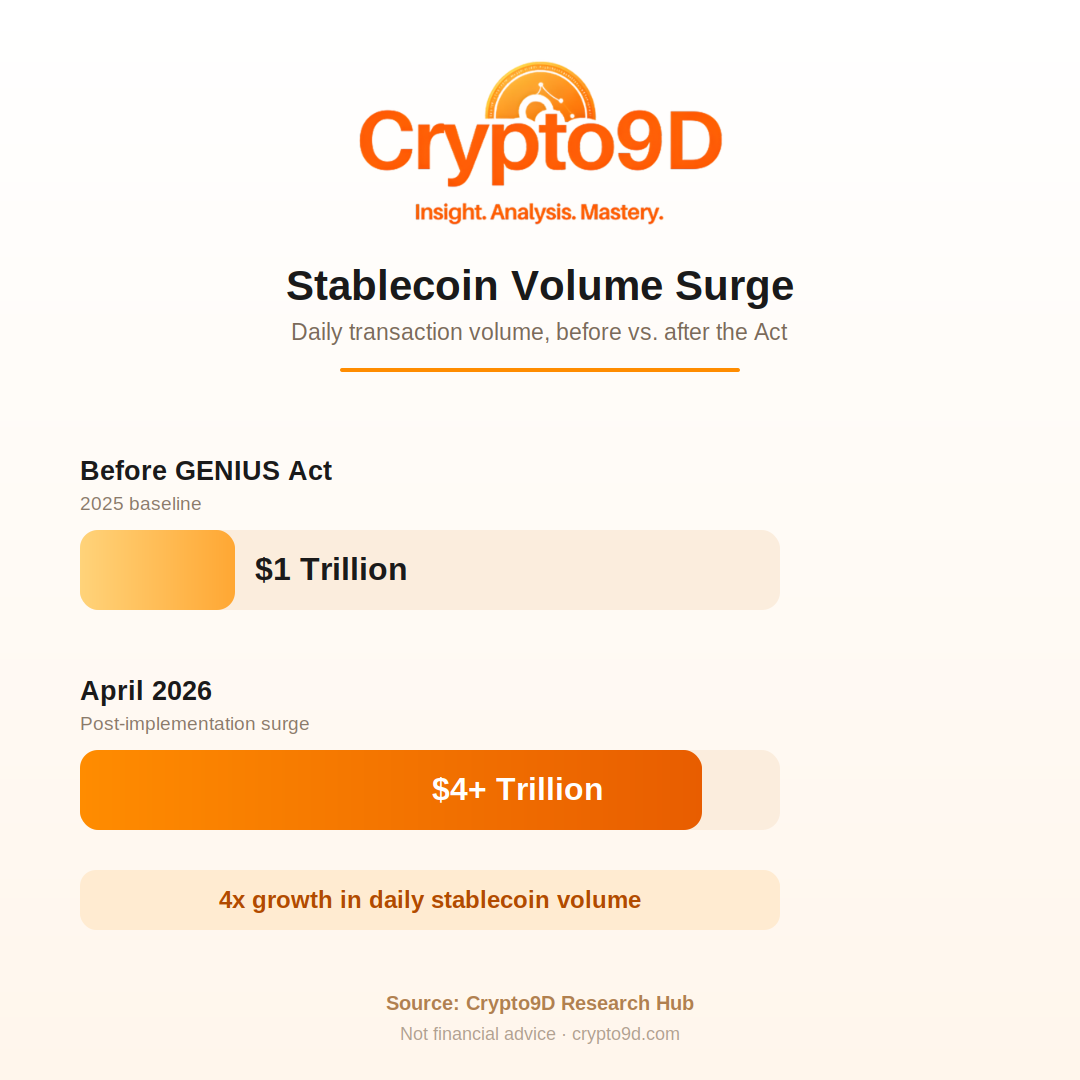
Reports indicate that daily stablecoin transaction volumes have seen “hockey stick” growth, surging from $1 trillion before the Act’s passage to over $4 trillion in April 2026. Experts attribute this to the Act’s success in embedding U.S. dollar dominance into digital finance, making dollar-pegged assets the “plumbing” of global cross-border payments.
4. Brookings Institution Analysis: The End of “Shadow” Crypto (March 2026)
A new analysis from the Brookings Institution highlights that the GENIUS Act has effectively created a path for non-bank fintech firms (like Circle and Paxos) to obtain limited federal bank charters. This move is professionalizing the digital asset space by allowing tech companies to compete with traditional banks while adhering to strict capital and risk management standards.
5. Implementation Countdown: January 18, 2027
While the Act was signed in 2025, regulators are currently working toward a July 18, 2026 deadline to finalize all implementing regulations. The industry is preparing for the “effective date” of January 18, 2027, by which time all stablecoins must be fully compliant with the 1:1 liquid reserve mandate or face removal from U.S. markets.
Conclusion
The GENIUS Act (2025) marks a historic shift in U.S. finance, transforming stablecoins from “gray-market” experiments into a regulated, bank-grade infrastructure.
By mandating 1:1 high-quality reserves, banning algorithmic models for payments, and granting holders legal priority during insolvencies, the Act effectively “upgrades” the U.S. dollar for the digital age. For market participants, the message is clear: compliance is now the primary competitive edge. As the industry moves toward full implementation by mid-2026, the focus will shift from speculative trading to the real-world utility of instant, transparent, and programmable global settlement.
Follow cryptp9D for in-depth crypto research and analysis
Closing remarks
The GENIUS Act (2025) transforms digital assets by shifting the industry from speculation to transparency. By mandating 1:1 liquid reserves and monthly audits, the law upgrades stablecoins into a legitimate, bank-grade payment infrastructure. For participants, the final advice is simple: prioritize compliance as a competitive edge, as the market will now favor regulated utility and instant settlement over the high-risk algorithmic models of the past.
Check Out Our Related Services
Ready to apply what you've learned about Bitcoin? Crypto9D offers expert services to help you navigate the crypto world with confidence:
Crypto Analysis
Get comprehensive analysis – fundamental, quantitative, qualitative, and on-chain – to make informed investment decisions.
Tokenomics Design
Get comprehensive analysis – fundamental, quantitative, qualitative, and on-chain – to make informed investment decisions.
Regulatory Compliance
Navigate complex Web3 regulations and ensure your project operates legally across all jurisdictions.
Crypto Education
Master crypto concepts with bespoke training programs tailored to your experience level.
This content is published for educational purpose only and its not a financial advice. see our disclaimer page for more details on our policy.
Related Articles:
Top 10 Promising AI, DePIN & RWA Projects – with High Growth Potential for 2026
Bybit Exchange Review 2026 – Institutional Power for Everyone
- Master the art of crypto scalping in 2026 – See how crypto scalping works
What Is Copy Trading? – How It Works
What Is Bitcoin and How Was It Created? – Bitcoin is the world’s first decentralized digital currency
What Are Crypto Wallets – How They Protect Your Funds
Liquidity in Crypto Trading – What It Means and Why It Matters
What Are ETFs – and How Are They Transforming the Way People Invest?
Top 5 Safest Crypto Exchanges – for Beginners:2026 Comprehensive Guide