
Is XRP a Smart Investment in 2026? Exploring the Future of Ripple’s Payment Network
- Crypto9D
- July 1, 2026
By 2026, the cryptocurrency market has matured far beyond its earlier speculative cycles. Investors today are far more selective, prioritizing projects that demonstrate regulatory progress, institutional relevance, and real-world use cases rather than hype-driven narratives. Within this evolving landscape, XRP, the native asset associated with Ripple, has re-entered serious investment discussions.
Once burdened by prolonged legal challenges and uneven price performance, XRP is now gaining renewed attention. The convergence of exchange-traded fund (ETF) activity, tightening token supply on exchanges, rising blockchain usage, and expanding institutional relationships has reshaped its outlook. This leads to an important question for investors: does XRP represent a solid investment opportunity in 2026, and what lies ahead for Ripple’s global payments vision?
This article examines XRP from multiple perspectives including market behavior, adoption trends, price expectations, risks, and long-term fundamentals to help readers form an informed, independent judgment.
XRP’s Evolution: From Uncertainty to Relevance
For much of the past decade, XRP’s reputation was overshadowed by regulatory ambiguity and intense competition from newer blockchain platforms. Price stagnation and negative sentiment caused many market participants to dismiss it as a fading project.
That narrative has shifted in 2026.
XRP has reclaimed its position among the largest digital assets by market capitalization, supported by renewed confidence from both individual traders and institutional investors. Unlike many cryptocurrencies that depend heavily on speculation, XRP is designed around a specific purpose: facilitating fast, cost-efficient cross-border value transfers.
Ripple’s long-standing objective has never been to replace banks, but to modernize the infrastructure they rely on. Instead of disrupting the system outright, Ripple focuses on improving settlement speed, reducing liquidity costs, and enhancing payment efficiency. In 2026, these goals are beginning to materialize at scale.
Market Performance and Investor Sentiment
XRP started 2026 with notable strength, outperforming several major cryptocurrencies during the early months of the year. While volatility remains a defining feature of digital assets, XRP’s price action reflects measured accumulation rather than short-lived speculative surges.
Consensus-based projections indicate that XRP’s medium- to long-term trajectory favors gradual appreciation. Conservative estimates suggest prices stabilizing between $1.80 and $2.00 by the early 2030s, while more optimistic models, accounting for stronger adoption and capital inflows to anticipate higher valuation ranges.
Technical indicators provide a balanced view. Moving averages suggest intermittent consolidation phases, while momentum indicators such as RSI remain largely neutral. This combination implies that XRP’s current market behavior resembles that of a developing financial asset, not a hype-driven token.
XRP ETFs and Institutional Capital Flows
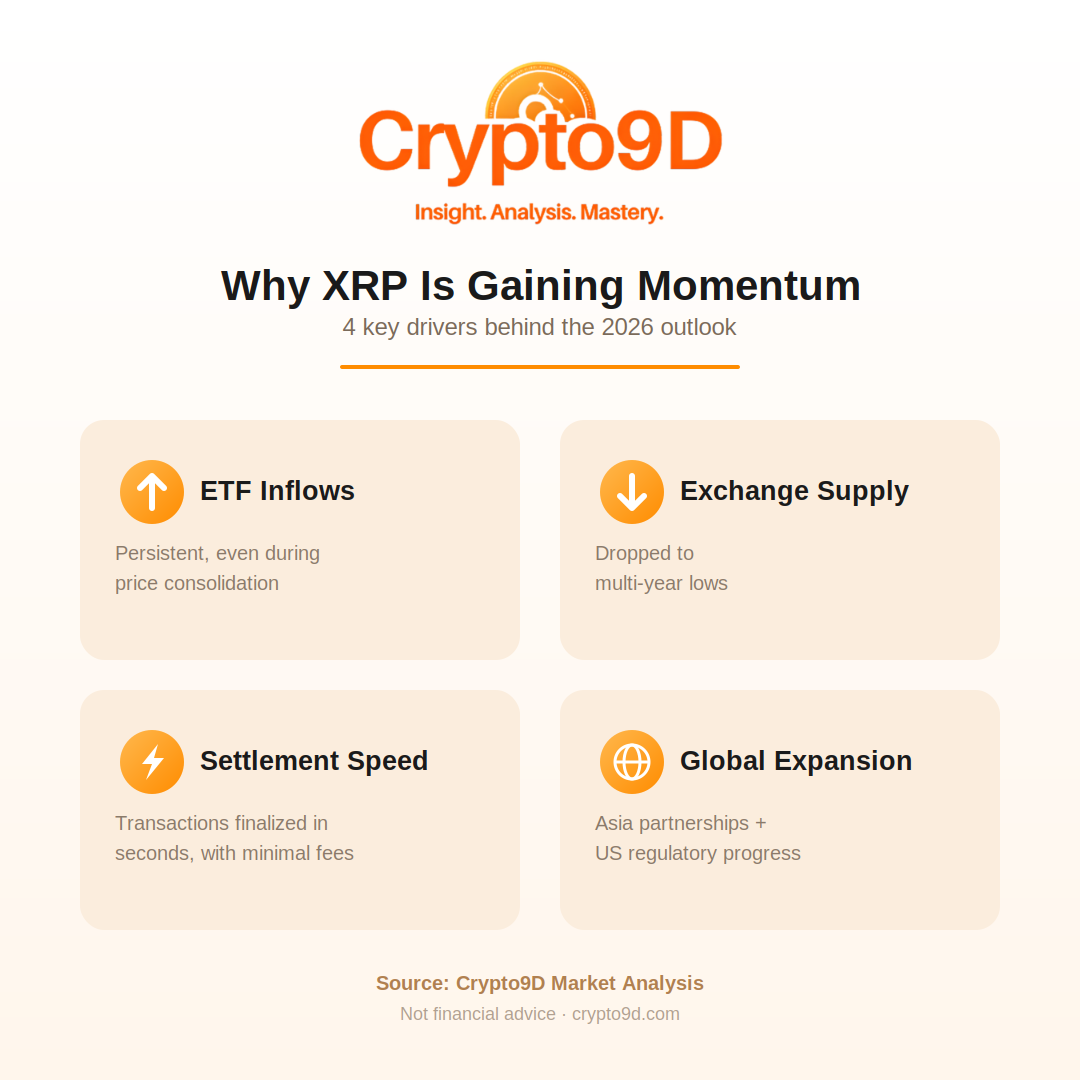
One of the most influential changes for XRP in 2026 has been the rise of spot XRP exchange-traded funds. These investment vehicles allow traditional investors to gain exposure without directly managing crypto assets, significantly lowering entry barriers.
Since their introduction, XRP ETFs have shown persistent inflows, even during periods of price consolidation. This behavior contrasts with the more reactive flows seen in Bitcoin and Ethereum ETFs, suggesting a longer-term positioning strategy among investors.
ETF participation has two major effects: it increases demand while simultaneously reducing available circulating supply, especially when paired with declining exchange balances. Together, these dynamics form a strong structural foundation for XRP’s valuation.
Shrinking Exchange Supply and Long-Term Holding Trends
Blockchain data reveals that XRP holdings on centralized exchanges have dropped to multi-year lows. Historically, this trend indicates that investors are shifting assets into private wallets, signaling longer holding periods rather than active trading.
Because XRP’s total supply is fixed, reduced liquidity on exchanges can have a meaningful impact on price behavior. As demand rises against a shrinking liquid supply, upward pressure tends to build gradually.
This stands in contrast to earlier market cycles, where sharp rallies were often followed by steep corrections. In 2026, XRP’s price structure suggests more controlled and sustainable movement, assuming adoption continues.
Ripple’s Payment Infrastructure: Why It Matters
The foundation of XRP’s value lies in Ripple’s payment technology. The network is built to enable near-instant settlement, low-cost currency conversion, and efficient cross-border transfers, addressing inefficiencies that exist in traditional systems like SWIFT.ks.
By 2026, Ripple’s infrastructure is actively supporting payment corridors where speed, liquidity access, and reliability are critical. Activity on the XRP Ledger has increased significantly, approaching transaction levels last seen during earlier adoption peaks.
Key benefits of Ripple’s model include:
- Transactions finalized in seconds
- Minimal transaction fees
- Reduced reliance on pre-funded accounts
- Improved liquidity efficiency for financial institutions
These advantages make Ripple’s network particularly appealing for banks, remittance providers, and emerging-market payment routes.
Expanding Global Partnerships
Ripple’s strategic expansion across Asia has strengthened its institutional credibility. Collaborations with major Japanese financial entities have positioned the XRP Ledger as a platform for regulated tokenization, digital securities issuance, and cross-border settlement solutions.
This adoption is not experimental. It represents deep integration into financial infrastructure, rather than short-term pilot programs.
In parallel, Ripple’s regulatory progress in the United States marks a milestone few blockchain companies have achieved. By engaging directly with regulators instead of avoiding oversight, Ripple has reduced one of the most significant long-term risks facing crypto projects.
Understanding XRP Price Forecasts
Forecasts for XRP’s future price vary widely, making it essential to distinguish realistic expectations from speculative extremes.
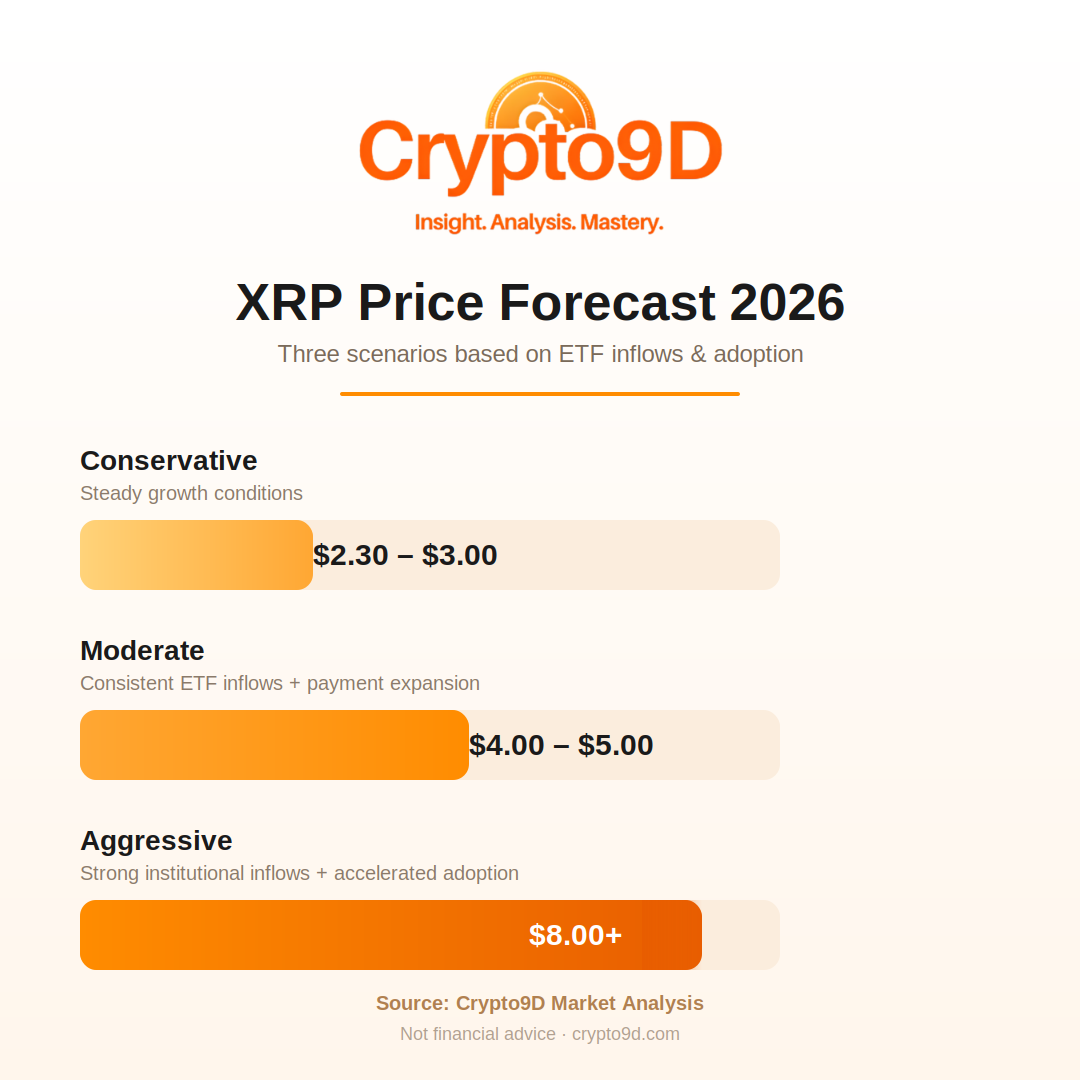
More cautious models suggest XRP trading in the $2.30–$3.00 range under steady growth conditions in 2026. Moderate scenarios, assuming consistent ETF inflows and gradual expansion of payment use cases, place XRP closer to $4.00–$5.00.
Aggressive projections envision prices exceeding $8.00, but these depend on substantial institutional inflows and accelerated global adoption. It is important to note that long-term projections beyond 2030 remain highly speculative, as they rely on assumptions that cannot be verified today.
Risks That Should Be Considered
Despite its improving fundamentals, XRP is not without challenges.
- Cryptocurrency markets remain inherently volatile
- Competing payment-focused blockchains could limit growth
- Regulatory frameworks may change across regions
- XRP may underperform during speculative market rallies
XRP is better suited for investors with longer time horizons rather than those seeking rapid, high-risk returns. Its appeal lies in resilience and utility rather than explosive price action.
Who Should Consider XRP in 2026?
XRP may be a suitable option for investors who prioritize:
- Practical blockchain use cases
- Institutional participation
- Steady, long-term growth
- Regulatory cooperation
Those focused on short-term trading or aggressive speculation may find XRP less compelling compared to more volatile assets.
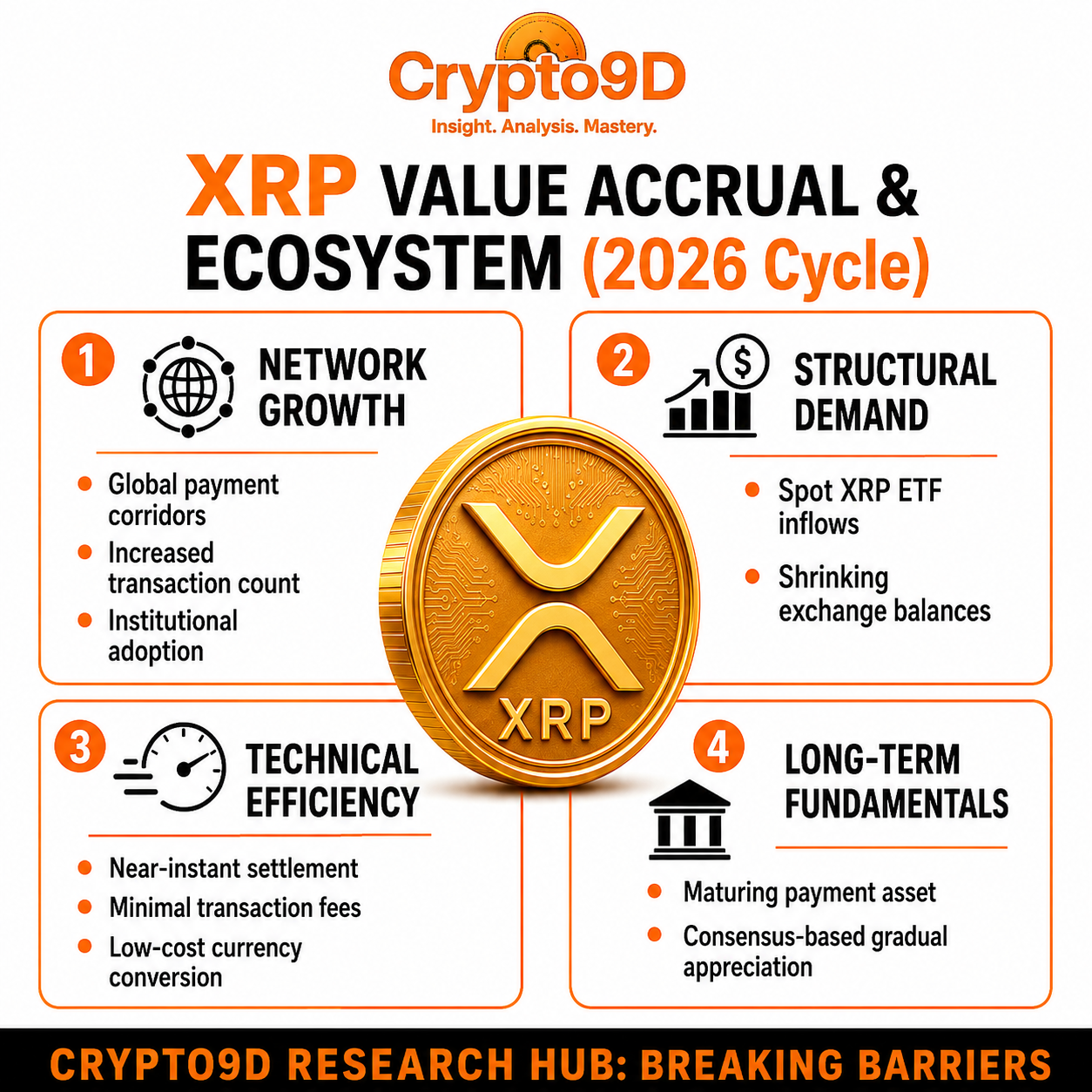
From a broader perspective, XRP represents a maturing digital asset centered on payments, supported by structural demand, shrinking liquid supply, and expanding real-world adoption.

User Case

This content is published for educational purpose only and its not a financial advice. see our disclaimer page for more details on our policy.
Conclusion: The Road Ahead for XRP and Ripple
By 2026, XRP’s narrative has shifted decisively from survival to execution. Ripple has moved beyond its most significant challenges and is now focused on scaling infrastructure, deepening partnerships, and integrating with global finance.
While no forecast is guaranteed, XRP’s fundamentals are stronger than they have ever been. For investors who believe blockchain technology will play a lasting role in global payments, XRP continues to offer a direct and differentiated exposure to that future.
As always, investment decisions should reflect personal risk tolerance and thorough independent research. XRP may not dominate headlines but in 2026, it stands as one of the most strategically positioned assets in the digital payments space.
Thinking about XRP or other long-term crypto opportunities?
Join Crypto9D to access in-depth market analysis, future-focused research, and unbiased insights that help you invest with clarity, not hype.
Related Articles:
Top 10 Promising AI, DePIN & RWA Projects – with High Growth Potential for 2026
Bybit Exchange Review 2026 – Institutional Power for Everyone
- Master the art of crypto scalping in 2026 – See how crypto scalping works
What Is Copy Trading? – How It Works
What Is Bitcoin and How Was It Created? – Bitcoin is the world’s first decentralized digital currency
What Are Crypto Wallets – How They Protect Your Funds
Liquidity in Crypto Trading – What It Means and Why It Matters
What Are ETFs – and How Are They Transforming the Way People Invest?
Top 5 Safest Crypto Exchanges – for Beginners:2026 Comprehensive Guide