
The Invisible Ledger: Why the Future of Web3 Won’t Mention Blockchain
- Crypto9D
- March 31, 2026

A Subtle Transformation in Motion
When people talk about Web3 they usually think of blockchain. They think about things like Bitcoin and Ethereum. Web3 is often thought of as being decentralized which means that Web3 is not controlled by one person or group.
The Current State of Web3 and Blockchain
People think about blockchain when they think about Web3 because blockchain is a part of Web3. Blockchain is like the foundation that Web3 is built on. Many people believe that blockchain is what makes Web3 work. They think blockchain is part of Web3.
People have built systems around blockchain and Web3. These systems are based on the idea that blockchain’s a key part of Web3. Blockchain is used to keep track of information in a way that’s fair and cannot be changed. This is a part of what Web3’s all about. Web3 and blockchain are closely linked in peoples minds.
People are starting to wonder if that is really true.
Something new is happening. It is not making a lot of noise. This is because it is happening behind all the excitement about technology and fancy upgrades.
More and more people who build things and do research are looking at Web3 in a way. They think Web3 can be powered by systems that’re fast and can be trusted, instead of by blockchain structures that are rigid. According to Ethereum Foundation’s Web3 research, alternative approaches are being explored to improve performance while maintaining decentralization. These systems do not need everyone in the world to agree on everything. They do not need to follow a strict order when it comes to transactions.
In this kind of world blockchain is still around, it is just not as noticeable as it used to be. Web3 is still powered by something. That something is still related to blockchain but it is not the main thing people see.
The Cost of Enforcing Order
The thing about blockchain is that it really wants everyone to be on the page when it comes to the order of transactions. Every single thing that happens has to be written down in a specific order that everyone on the network agrees on. This helps make sure everything is consistent and prevents problems like someone spending the money twice.
This way of doing things also causes some problems. It takes time for everyone to agree on what happened and when it happened. This means that transactions have to wait in line and be processed one by one. This is okay for things like sending money but it does not work well for more complicated things that need to happen fast.
As Web3 starts to be used for more than just payments like for real-time services and machines talking to each other this strict order starts to feel like it is getting in the way rather than helping. Blockchain is still a thing but this one rule is starting to feel a bit restrictive. The blockchain system is what is causing this issue because the blockchain has to have an order for all transactions. The blockchain transactions have to be, in a line. This is what makes it slow for the blockchain to process complex things.
Rethinking Trust: It’s About Proof, Not Process
People who work with Web3 think that blockchain is the way to make sure everything is trustworthy. The truth is, what really matters is being able to check that things are done correctly.
Web3 is really about making sure that when people do transactions they are real and cannot be changed. Blockchain does this by having everyone agree on what happened. There are other ways to do this without having every single person involved in every transaction in the exact same order.
This is a change in how we think about things.
If we can make sure that systems are honest without needing everyone to agree on everything then blockchain is not as important as we thought it was, for Web3.
A New Approach to Preventing Double-Spending
- Emerging systems show that security can work without one list.
- They let transactions happen on their own in groups.
- These transactions are then checked with codes to make sure they are okay.
- This way we do not need one list for everything.
- These new systems do not force all events into one line.
- They let many lines exist at the time.
- Each line can be. Is safe.
- This changes the idea that everything must be in order for it to be correct.
- New systems are not based on everyone agreeing on the order of things.
- They use groups and checks to make sure things are secure.
- Security is not about one list; it can work in many ways.
- Transactions can be safe, without a main list.
- These ideas are changing how we think about security and order.
Moving Beyond Sequential Thinking
Traditional blockchains work like a one way street where every transaction has to go through the route. When we use things like sharding or rollups to make them better they still work in a line.
Modern computers are really good at doing lots of things at the time. They can do operations simultaneously which makes them work much faster. If we use this idea for Web3 it will make the networks handle things without slowing down. This means we can make more flexible applications.
Instead of using just one blockchain the future might have many systems that are connected and work together. These blockchains will check everything on their own. Still work together smoothly and that is what the future of blockchains, like Web3 may look like. As noted by Ethereum Blog research on scaling solutions, Layer 2 networks and modular frameworks are evolving to support this vision.
Scaling Solutions or Temporary Fixes?
To fix performance problems the blockchain world has come up with ways to make it faster. Like Layer 2 networks, rollups and modular frameworks.
These methods do help make things more efficient. They are more like quick fixes than complete overhauls.
For example Layer 2 solutions move transactions off the chain and settle them later which helps with congestion right away but still relies on processing transactions in order.
Modular systems work in a way they split up tasks but still need some kind of sequence at their core.
These new ideas are helpful. They mostly improve what we already have instead of replacing it with something entirely new, like blockchain and Layer 2 networks.
The blockchain ecosystem still needs a fundamental change.
The Shift Toward Invisible Systems
As Web3 changes, what is important to people is changing too. People do not really care about how something works, they care about how it makes them feel. Web3 needs to be fast, not expensive and easy to use. These things are more important than the ideas behind Web3.
This is why we are seeing invisible infrastructure” now. This means system is decentralized. You do not notice it.
In this way of doing things:
- Transactions happen right away
- Costs are very low. You do not even notice them
- Everything gets verified automatically
- People use the applications, not the underlying protocols
Blockchain is one part of the system, it is not the only thing used. Web3 uses blockchain when it needs to, not all the time.
AI and the Need for Speed
The next phase of Web3 will probably not have people but also computer programs that can think for themselves. These computer programs will be controlled by intelligence and they will talk to each other all the time. They will make deals and decisions faster and at a much bigger scale than people can.
These new systems will need a things to work properly:
- Immediate confirmation
- They have to be able to do lots of things at the time
- They have to be able to change and adapt quickly
- If every action has to wait in line to be checked the system will be too slow.
So these new systems will use a way of checking actions. They will check them where they happen, not in a line.
The next phase of Web3 will probably not have people but also computer programs that can think for themselves. These computer programs will be controlled by intelligence and they will talk to each other all the time. They will make deals and decisions faster and at a much bigger scale, than people can.
- These new Web3 systems will need a things to work properly:
- Immediate confirmation
- They have to be able to do lots of things at the time
- They have to be able to change and adapt quickly
If every action has to wait in line to be checked the Web3 system will be too slow.
So these new Web3 systems will use a way of checking actions. They will check them where they happen, not in a line.
Decentralization Without a Single Ledger
Blockchain is often thought of as being about decentralization. Decentralization is actually a much bigger idea. Decentralization is about how people’re in charge, how we make sure information is correct or how people get to be a part of something.
These things can happen even if we do not have one book that everyone shares.
Actually a lot of blockchain networks are starting to look more centralized with a few people having a lot of power. This makes us wonder: is blockchain really the way to make things decentralized?
Some new ideas suggest that it might be better to spread out the process of verifying information than making everyone follow the same rules. This could be a way to balance being efficient and being open which is what blockchain is supposed to be about, decentralization and blockchain.
A Supporting Role for Blockchain
Blockchain is not going to go. It will probably become a behind the scenes thing.
It will not be the thing that processes everything.
Blockchain may be used for:
- A final settlement mechanism
- A system for resolving disputes
- A secure anchor for proofs
In this way blockchain is only used when it is really necessary. Most of the time other things will be doing the work.
This is like what has happened to technology. They started out as the main thing but now they are just a small part of a bigger system. Blockchain is going to be like that. Blockchain will be used to help the system but it will not be the main thing that people see.
The Challenge of Letting Go
Moving away from the idea that blockchain’s the center of everything will not be simple. The current system has a lot of money, jobs and beliefs tied up in keeping blockchain important.
For a lot of people blockchain is more than a technology it represents being free, open and not controlled by a central power. When you question if blockchain is really needed it can feel like you are questioning those values.
But sometimes we have to rethink the basics of technology in order to move forward with ideas and blockchain is no exception, to this rule blockchain needs to be rethought.
Learning from the Internet’s Evolution
The history of the internet is an example to look at. The internet started with systems that were not very flexible and were controlled by people. Over time these systems changed and became more open which allowed a lot of new ideas to happen.
Today some parts of Web3 are getting too complicated and hard for people to use. Which is actually the opposite of what Web3 was supposed to do.
The next step for Web3 will probably focus on an important things, such as:
- Ease of use
- Performance
- Being useful in life instead of just being speculative
This might mean that Web3 will start to move away from the traditional blockchain systems that it is based on.
Per OpenSea’s evolution in Web3 user experience, the industry is actively improving accessibility and usability across platforms.
The Concept of an Invisible Ledger
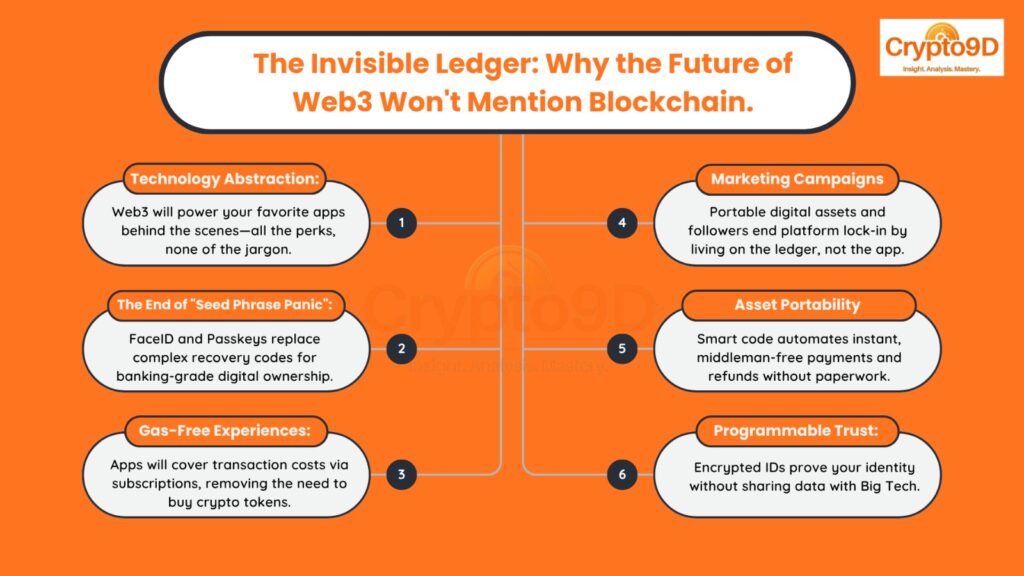
Looking ahead, the main thing that defines Web3 might not be that it has a ledger. That users do not even notice it is there.
Trust will still be there; it will just be part of how the system works and it will do its job quietly.
In this vision:
- Transactions get checked automatically
- Systems talk to each other by sharing proof not by using the database
- You still own things. It is not hard to understand
- Applications are easy to use and do not have parts
- The ledger is still around. But it is not the main focus.
- It works behind the scenes.
User Case:
The “Invisible” Example: The Gaming Passport
- The User View: You play a mobile game, earn a “Rare Sword,” and log in using your FaceID. You then open a different game by a different studio, and that same sword is in your inventory, ready to use.
- The Ledger Reality: The sword is an NFT on a blockchain. When you move games, a smart contract verifies your ownership instantly.
- The “Invisible” Part: You never bought “Crypto,” you never saw a “Wallet Address,” and you didn’t pay a “Gas Fee.” You just played the game.
Why it’s better (The "So What?")
|
Old Web (Web2)
|
Invisible Web3 (2026)
|
|---|---|
|
Locked In: Your items die if the game shuts down.
|
Portable: You own the item; it lives on the ledger, not the server.
|
|
Passwords: Easy to hack or forget.
|
Passkeys: Secure biometrics replace 24-word seed phrases.
|
|
Middlemen: The App Store takes 30% of every sale.
|
Direct: Creators get paid instantly via automated code
|
In the future, “Blockchain” will be like “WiFi”—a background utility you only notice if it stops working.
Conclusion
Web3 is still new. We do not know what it will be like when it is finished. The blockchain has been very important in deciding what Web3 will be. It has given us ideas about owning things, trusting people and working together.
- But now that Web3 is getting older we are starting to see that the blockchain might not be the goal.
- It might just be a way to get to something that gives us the same good things without the bad things.
- The future of Web3 might not be about blockchains at all.
- That does not mean blockchains are not important.
- It just means they did a job of getting us ready, for something even better.
Learn More About Web3's Evolution
Want deeper crypto insights that actually matter?
Join Crypto9D and stay informed, prepared, and ahead of the market.
Related Articles:
Top 10 Promising AI, DePIN & RWA Projects – with High Growth Potential for 2026
- Master the art of crypto scalping in 2026 – See how crypto scalping works
What Is Copy Trading? – How It Works
What Is Bitcoin and How Was It Created? – Bitcoin is the world’s first decentralized digital currency
What Are Crypto Wallets – How They Protect Your Funds
Liquidity in Crypto Trading – What It Means and Why It Matters
What Are ETFs – and How Are They Transforming the Way People Invest?
Top 5 Safest Crypto Exchanges – for Beginners:2026 Comprehensive Guide