What are the best tokenized investing platforms for accessing exclusive global markets?
- Crypto9D
- June 19, 2026
Introduction: The End of Closed Investment Systems
For a time people who invest their money had to deal with a lot of restrictions. They did not have access to investment opportunities like private equity or big real estate deals. These opportunities were mostly available to companies and people with a lot of money. Everyone else could only invest in markets which had fewer options and did not grow as fast.
This is all changing now.In 2026 tokenized investing is making it possible for people to invest in markets that were not available before.This is not about using new technology. It is about changing the way people can invest their money.Now people can own things digitally, make transactions quickly and more people can participate in investing.For anyone who wants to make money in today’s world it is very important to understand what is happening with investing.
Tokenized investing is becoming a part of building wealth and people need to know about it.
Understanding investing is no longer something people can choose to do. It is something they have to do.
Accessing exclusive global markets in 2026 has moved beyond traditional banking, shifting toward a decentralized and digitized landscape. Whether you are looking for institutional-grade assets or emerging tech sectors, here is a breakdown of how to gain entry.
1. The Tokenization of Real-World Assets (RWA)
One of the most direct ways to access “exclusive” markets like luxury real estate, fine art, or gold is through fractional ownership. By using blockchain-based ledgers, high-value assets are divided into digital tokens. This allows you to invest in a multi-million dollar office building or a private credit fund with a fraction of the traditional capital required.
Access Point
Platforms like Bybit (via Unified Trading Accounts) and specialized RWA marketplaces.
Key Trend
Moving away from “paper” ownership toward 24/7 liquid on-chain assets.
The global market is currently being reshaped by the AI-led capex boom. Accessing this market involves moving beyond just buying chipmaker stocks and looking at the infrastructure level:
Power & Energy
Investing in the energy grids and nuclear technologies required to sustain massive AI data centers.
Modular Blockchains
Accessing exclusive early-stage decentralized networks that provide the “computing layer” for autonomous AI agents.
Strategic Entry
Using ECN (Electronic Communication Network) brokers like IC Markets or XTB to trade specific sector-themed baskets.
3. Digital Asset Exchanges and Institutional Suites
For those seeking “institutional power for the everyman,” modern exchanges have bridged the gap between retail trading and high-level finance.
Unified Trading Accounts (UTA)
Yield Auto-Compounding
Utilizing smart contracts to automatically reinvest returns from global liquidity pools, a strategy previously reserved for hedge fund “quant” desks.
4. Direct Global Brokerage & CFD Infrastructure
Accessing international jurisdictions (like Asian or European emerging markets) is now standard through high-execution retail brokers. In 2026, the focus is on low-latency execution and raw spreads.
Platforms
MetaTrader 5 (MT5) and cTrader remain the gold standard for connecting to global liquidity.
Benefits
These provide direct access to global indices (like the Nikkei 225 or DAX 40) and commodities (lithium, carbon credits) with minimal deposit thresholds often as low as $10 to $25.
5. Social and Copy-Trading Ecosystems
If you lack the time for deep forensic-grade research, “exclusive” market insights can be accessed through social-led trading.
CopyPortfolios
Platforms like eToro or Bybit’s Copy Trading allow you to mirror the trades of verified “Master Traders” who specialize in specific niche markets like Web3 gaming or micro-cap altcoins.
The Logic
It turns market participation into a collaborative effort, leveraging the expertise of specialists who have the tools to track illicit fund movements or detect “1000x” opportunities before they hit the mainstream.
Summary Table: Market Access Evolution
|
Market Type
|
Traditional Access
|
2026 Access Method
|
|---|---|---|
|
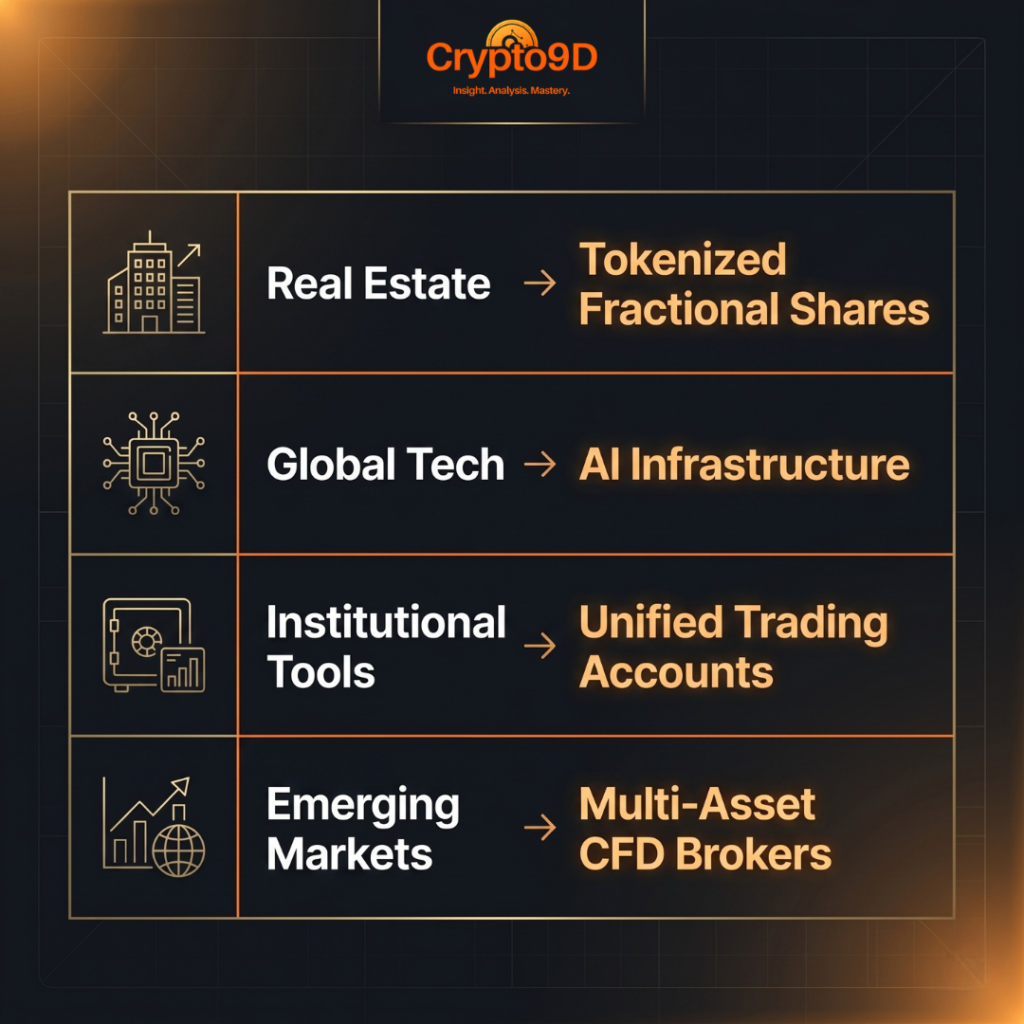
Real Estate
|
High capital, legal fees
|
Tokenized Fractional Shares
|
|
Global Tech
|
Direct Stock Purchase
|
AI Infrastructure/Modular Rollups
|
|
Institutional Tools
|
$1M+ Net Worth
|
Unified Trading Accounts (UTA)
|
|
Emerging Markets
|
Local Bank Accounts
|
Multi-Asset CFD Brokers
|
Tokenized Investing: A New Model of Ownership
At its tokenized investing means holding digital units that represent ownership or rights in an asset. This is different from systems like brokerage accounts or paper-based ownership. Assets are shown on blockchain networks as tokens instead. These tokens can be transferred, divided and managed digitally. They can represent:
- Shares in a company
- Parts of estate
- Debt instruments, like bonds
- Commodities or infrastructure assets
- Rights to income or future returns
This approach makes investing more flexible. It is also more transparent and globally accessible.
Tokenized investing changes the way we invest. It uses tokens to represent assets. This makes it easier to invest.
Real-World Asset Tokenization: The Bridge Between Old and New
The thing that makes tokenized investing work is taking things and turning them into tokens. This means we take something that exists in the world like a house or a share of a company and we make a digital version of it. Each token is like a piece of the real thing so when you own a token you own a small part of that thing like a house or a company or you have a certain right to get some money from it. Tokenized investing is all about these tokens and how they can be used to represent real-world assets like a house or a share of a company in a way.
For example:
- A building can be split into thousands of tradable units
- A loan portfolio can be digitally represented and distributed
- A fund can issue programmable ownership shares
The significance lies in what this enables: assets that were once static and illiquid become dynamic and easier to exchange.
Why Blockchain Makes This Possible
Tokenized systems rely on blockchain technology because it introduces a new way of recording and verifying ownership.
Here’s what it changes:
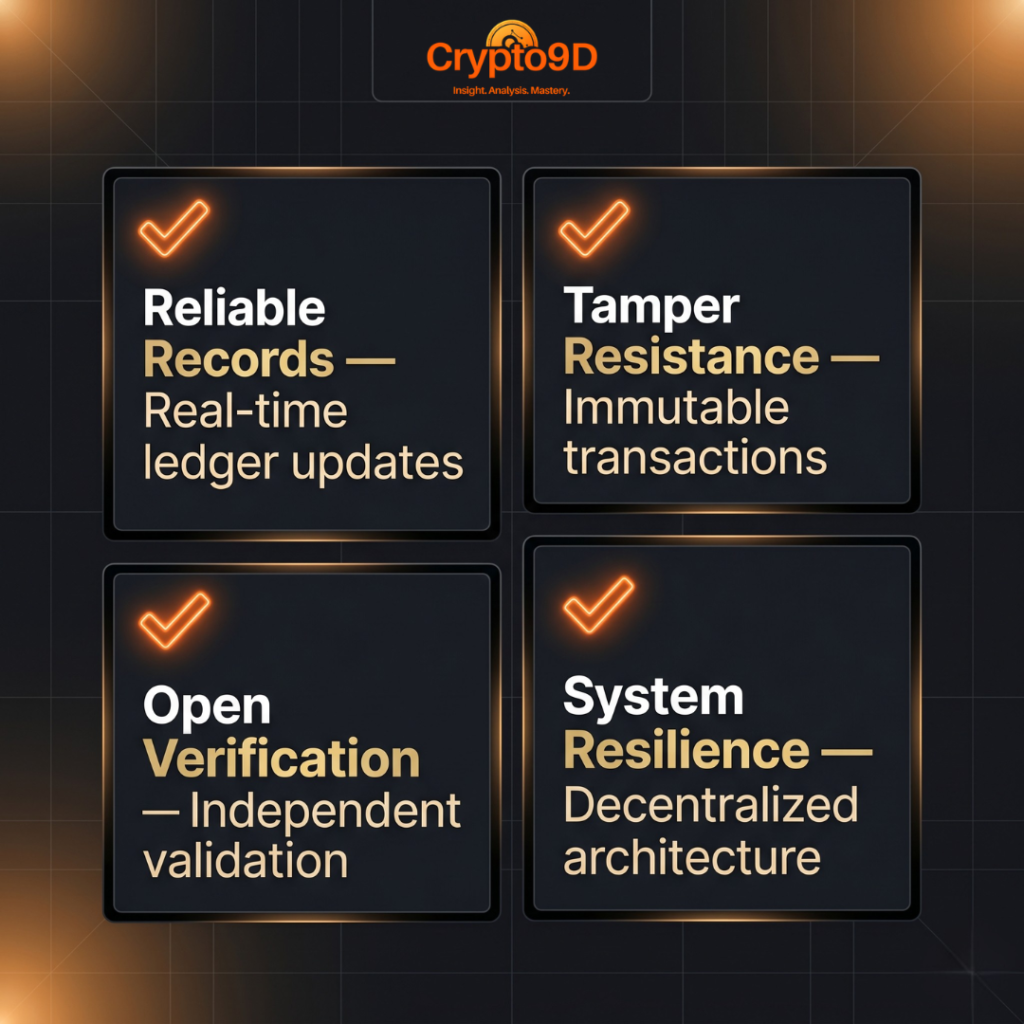
Reliable Record-Keeping
Ownership is stored on a shared ledger that updates in real time.
Tamper Resistance
Once recorded, transactions are extremely difficult to alter.
Open Verification
Participants can validate transactions without relying on a central authority.
System Resilience
Decentralized networks reduce the risk of single points of failure.
This creates a more dependable infrastructure compared to fragmented traditional systems.
Smart Contracts: Turning Rules Into Code
Smart contracts are a part of tokenized investing. They are programs on the blockchain that automatically follow set rules.
In life this works like this:
- Tokens get issued on their own
- Transfers happen with rules that follow regulations
- Income gets distributed without someone having to do it
- Eligibility checks happen away
This makes slow manual work go away and replaces it with constant automated action.
The outcome is a system that works faster and does things the way every time. It makes things quicker and more consistent. Smart contracts make tokenized investing more efficient. They help make the process smoother. The use of contracts is important in tokenized investing.
From Limited Access to Global Participation
The impact of tokenization is really big because it changes who can invest in things.A lot of people were not able to use financial systems before.Over time online banking made it possible for more people to make payments and save money. Now tokenized investing is helping more by giving people a way to invest in capital markets and that is a big deal for tokenized investing.A growing number of individuals worldwide still lack access to investment opportunities. Tokenized systems aim to reduce that gap by:
- Lowering entry requirements
- Removing geographic limitations
- Enabling direct participation through digital platforms
This marks a shift from restricted participation to broader inclusion.
The Rise of Borderless Investment Networks
In 2026, investing is becoming less tied to physical locations.
Tokenized markets operate through digital infrastructure, allowing:
- Participation across countries
- Continuous trading cycles
- Access through mobile devices
This creates what can be described as a global investment layer where assets and capital move more freely than in traditional systems.
Token Standards: Creating Order in a Digital System
For tokenized markets to function properly, standardization is critical.Different frameworks are emerging to ensure that tokens are secure, compliant, and interoperable.
Some standards focus on:
- Embedding regulatory rules into tokens
- Controlling how assets can be transferred
- Ensuring compatibility across platforms
These structures help align digital assets with legal and institutional requirements, making large-scale adoption more feasible.
Continuous Markets: A New Speed of Finance
Traditional financial systems are defined by delays.
Markets open and close at fixed times, and transactions often take days to settle.
Tokenized systems change this dynamic:
- Markets operate continuously
- Transactions finalize almost instantly
- Capital is not tied up during settlement periods
This increases efficiency and allows investors to respond more quickly to opportunities.
Fractional Ownership: Lowering the Barrier to Entry
Tokenization allows assets to be divided into smaller units, making them more accessible.
This has several effects:
- High-value assets can be shared among many investors
- Diversification becomes easier with limited capital
- Entry into premium markets becomes more realistic
Instead of requiring large sums, investors can participate at a scale that matches their resources.
Real-World Use Cases Gaining Traction
Tokenized investing is already being applied across industries.
Property Markets
Digital ownership units allow investors to access real estate without purchasing entire properties.
Debt Instruments
Bonds and loans are issued with automated payment structures.
Private Investments
Funds and startups distribute ownership through digital tokens.
Commodities
Physical resources are represented digitally for easier trading.
These use cases show that tokenization is moving beyond experimentation into practical application.
Regulation: From Uncertainty to Structure
Clear regulatory frameworks are essential for long-term growth.
By 2026, progress is being made in:
- Defining categories of digital assets
- Recognizing token-based ownership legally
- Integrating compliance into digital systems
This shift provides confidence for both investors and institutions.
Built-In Compliance: A New Approach to Oversight
In traditional systems, compliance is handled externally.
Tokenized systems integrate compliance directly into the asset.
This allows:
- Automated identity verification
- Controlled participation
- Real-time monitoring of transactions
Instead of being a separate process, compliance becomes part of the system’s design.
Challenges That Still Exist
Despite its advantages, tokenized investing is not without obstacles.
Key challenges include:
- Differences in legal frameworks across regions
- Technical risks in digital systems
- Limited integration between platforms
- Ongoing need for education and awareness
Recognizing these limitations is important for realistic expectations.
Skills Required for the New Investment Landscape
To navigate tokenized markets effectively, individuals should develop:
Financial Knowledge
Understanding risk, return, and asset behavior remains essential.
Technical Awareness
Basic familiarity with blockchain systems is increasingly important.
Regulatory Understanding
Awareness of legal frameworks helps avoid compliance issues.
Critical Evaluation
Assessing opportunities carefully is key to long-term success.
Getting Started: A Practical Approach
Entering tokenized markets does not require immediate expertise.
A gradual approach works best:
- Learn foundational concepts
- Observe how platforms operate
- Start with small-scale participation
- Stay updated on industry developments
Progress comes from consistent learning and practical exposure.
A Structural Shift in Global Investing
Tokenized investing represents a deeper transformation in financial systems.
It reflects a move from:
- Restricted access → Wider participation
- Slow processes → Real-time execution
- Localized systems → Global connectivity
This is not a temporary trend, it is part of a long-term evolution.
Latest Happenings in Tokenized Investing
Here are the latest news developments from April 2026 that showcase how tokenization is opening up exclusive markets to a broader range of investors.
1. Tokenized Asset Market Hits $27.6 Billion (April 2026)
As of early April 2026, the global tokenized asset market has reached a record $27.65 billion. While U.S. Treasuries make up nearly half of this value ($12.78 billion), the growth signals a massive shift in how “safe-haven” institutional assets are being accessed by digital-native investors.
Key takeaway: Institutional-grade yield is no longer locked behind private banking desks; it is moving directly onto public ledgers.
2. Private Equity Tokenization Solves the “Liquidity Lock” (April 2026)
New industry analysis highlights how private equity, historically one of the most exclusive and illiquid asset classes, is being transformed. In April 2026, platforms were successfully using smart contracts to automate compliance and allow fractional ownership, enabling smaller investors to enter deals that previously required multi-million dollar minimums.
Key takeaway: Tokenization allows for “secondary market creation,” meaning investors can exit private equity positions earlier than traditional 7-10 year lock-in periods.
3. BlackRock’s BUIDL Fund Surpasses $2.5 Billion (April 2026)
BlackRock’s USD Institutional Digital Liquidity Fund (BUIDL) remains a dominant force, now holding over $2.5 billion in assets. Major financial players are increasingly using these tokenized funds as the “backbone” for new retail products, essentially letting everyday savers earn institutional yields through “on-chain neobanks.”
Key takeaway: High-level institutional products are being “repackaged” through tokens to reach retail users via apps like Robinhood and Ether.fi.
4. SEC Explores “Modernizing Capital Markets” (April 23, 2026)
A new submission to the SEC titled “Tokenization and the Future of Securities” discusses the urgent need to update federal laws to support on-chain IPOs and tokenized bond issuance. The report emphasizes that updating “broker” and “custody” definitions is essential to allow for non-custodial secondary trading.
Key takeaway: Regulatory momentum is building to allow “on-chain IPOs,” which would let the general public invest in startups and bonds with the same ease as buying a token.
User Case
To understand the “New Financial Literacy” of 2026, think of tokenization as the process of turning a high-value physical asset into a digital “mosaic” where you can own a single tile.
Here is a practical example of how a student in 2026 might use tokenization to build wealth, rather than just saving cash.
The Scenario: Investing in a Student Rental Property
In the past, if you wanted to invest in real estate, you needed $50,000 for a down payment. In 2026, through Fractionalized Tokenization, you can start with $50.
1. The Asset
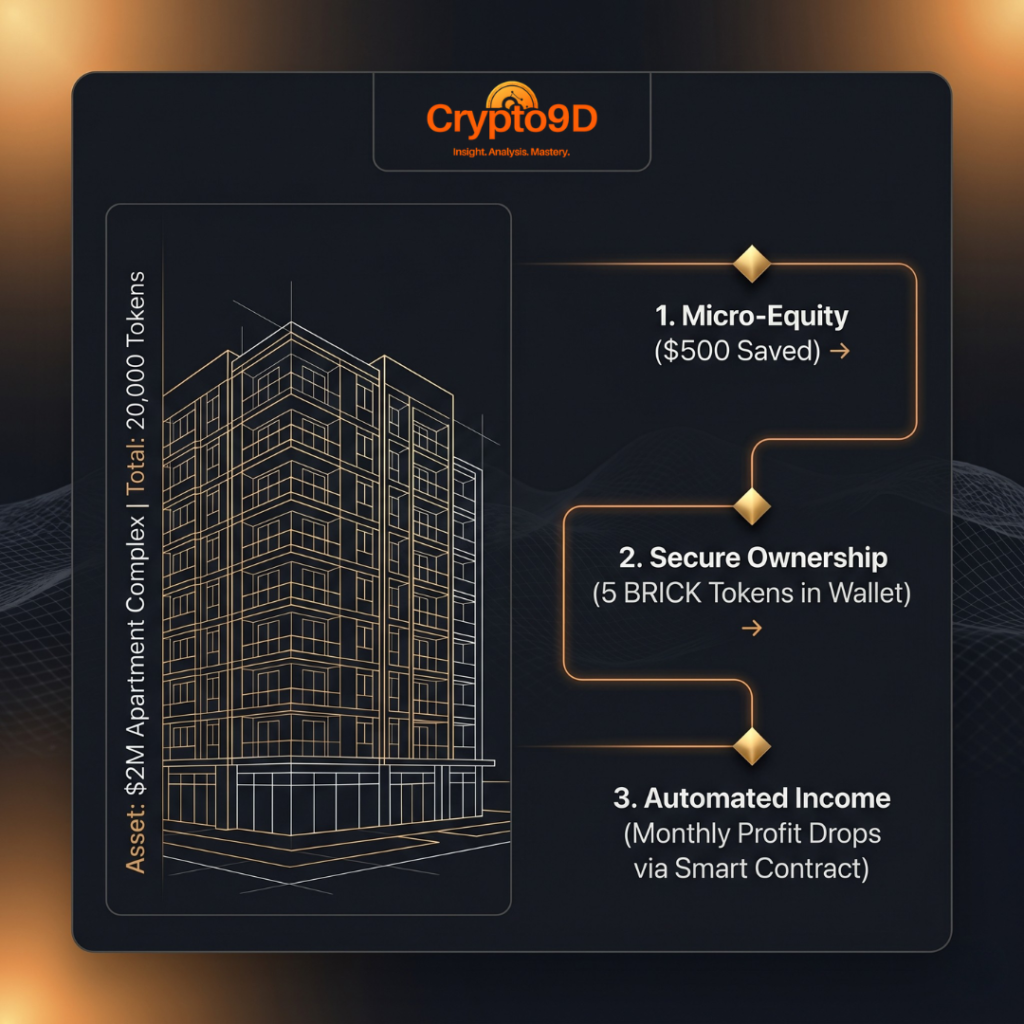
Imagine a modern, 10-unit apartment complex near your university valued at $2 million. The owner decides to tokenize the building on a blockchain.
2. The Tokenization Process
The building’s value is divided into 20,000 digital tokens, each representing a share of the property. At $2,000,000 total value, each token is worth $100.
3. The Student Investment
As a student, you have $500 saved from a summer job. You don’t buy a whole building; you buy 5 tokens.
- Ownership: Your digital wallet now holds 5 “BRICK” tokens, which are legal proof of your fractional ownership.
- Dividends: Every month, the tenants in that building pay rent. A Smart Contract automatically distributes that rent to all token holders. If your 5 tokens represent 0.025% of the building, 0.025% of the total monthly profit is instantly dropped into your digital wallet.
4. Liquidity (The Big Change)
In the old world, selling real estate took months. In 2026, if you need money for textbooks, you can go to a digital exchange and sell 1 of your “BRICK” tokens to another student in seconds. You get the cash instantly, and they get the future rental income.
Why this is “Essential Financial Literacy”
By 2026, students must understand three core shifts that this example highlights:
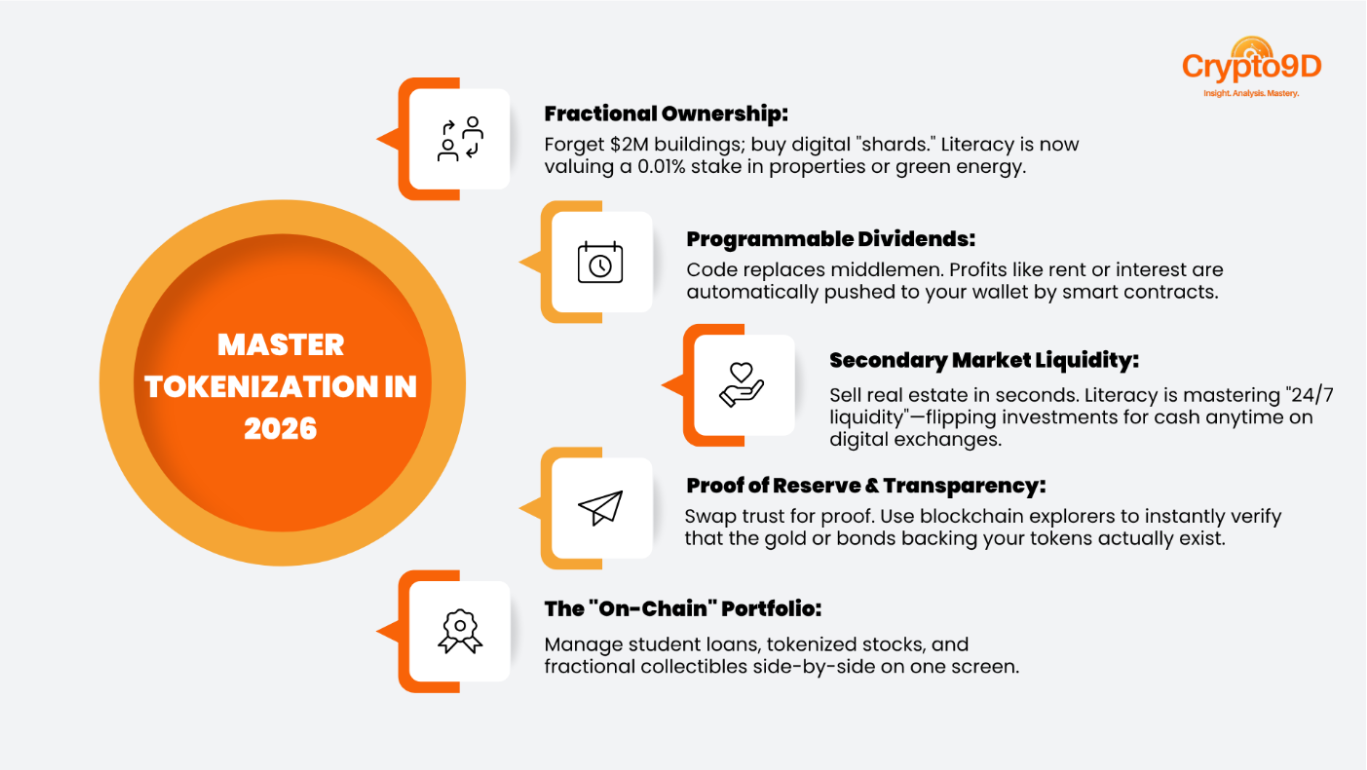
- From “Savings” to “Microsquity”: Instead of keeping $100 in a bank account where inflation eats it, students “park” their money in tokens of appreciating assets (gold, art, or real estate).
- Automated Accounting: You no longer need a lawyer or a broker to verify your ownership. The Blockchain serves as the “source of truth.”
- Global Access: A student in London can buy a $10 token representing a fraction of a solar farm in Africa or a high-end commercial building in Tokyo, diversifying their portfolio instantly from a smartphone.
Summary: Tokenization turns the world’s most expensive assets into “Lego pieces” that anyone can buy, sell, and earn from, regardless of how much money they have in the bank.
Conclusion: Access Is the New Advantage
The biggest change in 2026 is not about how we invest. It’s about who can join in.Tokenization is helping to remove the obstacles that once stopped people from accessing markets.This is creating systems that’re more open, efficient and fair for everyone.For investors today the key is to understand these changes on.Those who adapt quickly will not just keep up with the market. They will be in a position to benefit from its changes.Tokenized investing is changing the way we access markets.In today’s financial world having access is crucial.Tokenization is making investing more accessible.It is creating opportunities for people to invest.The tokenization of assets is redefining access to markets.Access to markets is everything, in today’s financial world.
Step beyond traditional investing and explore what’s next with crypto9D your entry point into tokenized assets, global opportunities, and the future of digital finance. Start building your advantage today.
Closing Note
The democratization of investment through tokenization has effectively dismantled the barriers to once-exclusive markets, shifting the power from institutional gatekeepers to individual investors. In 2026, mastering this landscape means leveraging fractional ownership to build a diversified portfolio of high-yield assets that were previously out of reach. By staying informed on regulatory standards and prioritizing platform security, you can capitalize on a more inclusive financial system built for transparency and global scale.
Related Articles:
Top 10 Promising AI, DePIN & RWA Projects – with High Growth Potential for 2026
- Master the art of crypto scalping in 2026 – See how crypto scalping works
What Is Copy Trading? – How It Works
What Is Bitcoin and How Was It Created? – Bitcoin is the world’s first decentralized digital currency
What Are Crypto Wallets – How They Protect Your Funds
Liquidity in Crypto Trading – What It Means and Why It Matters
What Are ETFs – and How Are They Transforming the Way People Invest?
Top 5 Safest Crypto Exchanges – for Beginners:2026 Comprehensive Guide