
Is Your Seed Phrase Safe? Preparing for Post-Quantum Encryption in Web3
- Crypto9D
- July 14, 2026
For most people in crypto, a seed phrase feels like the ultimate safety net.
Twelve or twenty-four words. Write them down. Store them offline. Never share them. If you follow the rules, your assets are safe or so we’ve been told.
That assumption has held up remarkably well in the classical computing era. But as Web3 matures and quantum computing moves from theory to early reality, a new question is quietly emerging:
Key Takeaways
Is your seed phrase still safe in a post-quantum world?
This isn’t about panic. It’s about preparation.
Just like the industry slowly woke up to hardware wallets, multi-sig, and account abstraction, post-quantum encryption is the next layer of security evolution and Web3 needs to think about it before it’s urgent.
Why Seed Phrases Work Today?
Seed phrases are powerful because they rely on asymmetric cryptography.
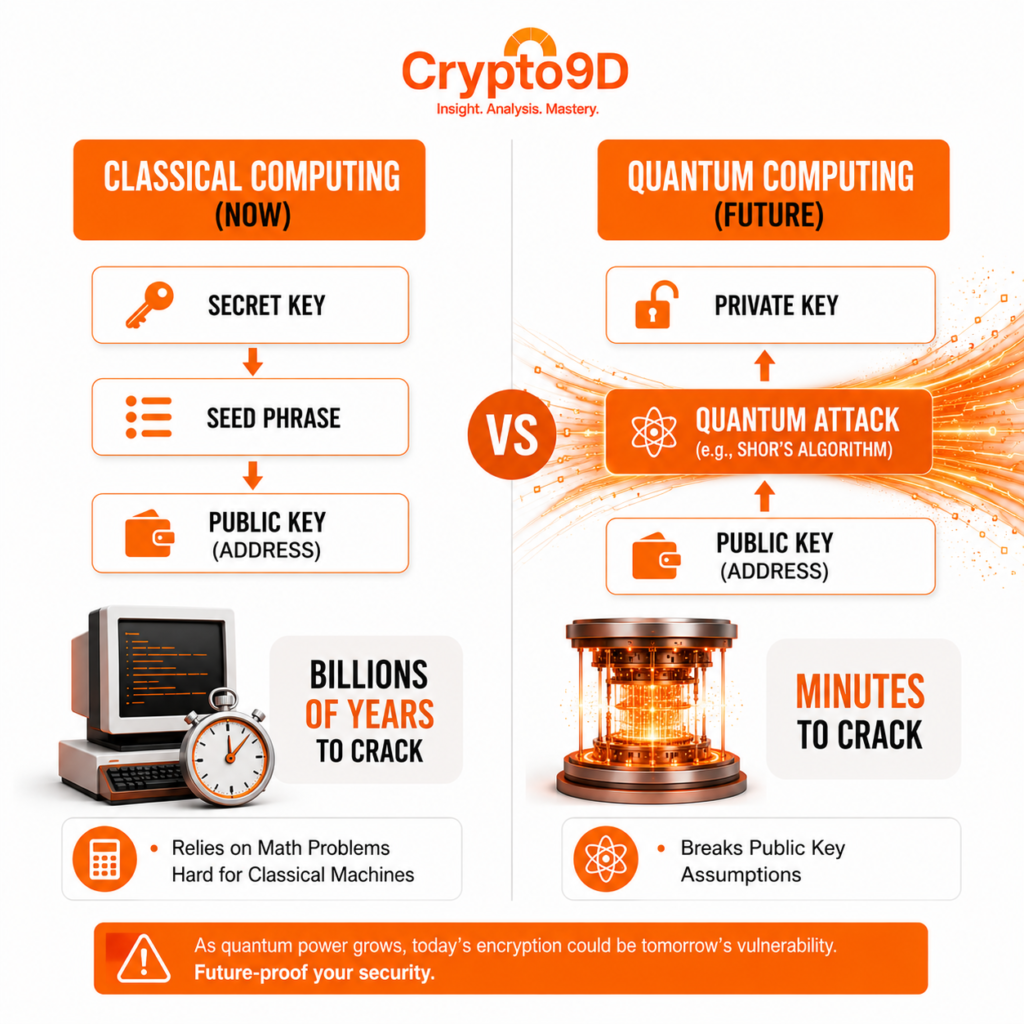
Behind those words is a private key, mathematically linked to a public key. Current blockchain security assumes that deriving the private key from the public key is computationally infeasible with classical computers.
This is what protects:
- Wallet ownership
- Transaction signing
- Smart contract permissions
- Identity and access control across Web3
In short, whoever controls the private key controls the assets.
As long as attackers can’t reverse the math, seed phrases remain secure even if someone sees your public address thousands of times.
The Quantum Threat (Without the Hype)
Quantum computers don’t break encryption today. That part matters.
But unlike classical computers, quantum machines can solve certain mathematical problems exponentially faster. Algorithms like Shor’s algorithm directly target the cryptographic assumptions used in many blockchain systems.
This doesn’t mean:
- All wallets will suddenly be hacked
- Seed phrases will instantly become useless
- Crypto collapses overnight
What it does mean is that long-lived keys addresses reused for years, cold wallets holding large balances, treasuries, DAOs, and smart contracts, face a new risk model.
If a sufficiently powerful quantum computer appears, previously safe public keys could become attack surfaces.
And unlike a password breach, cryptographic failures don’t come with warnings.
“Harvest Now, Decrypt Later” Is the Real Concern
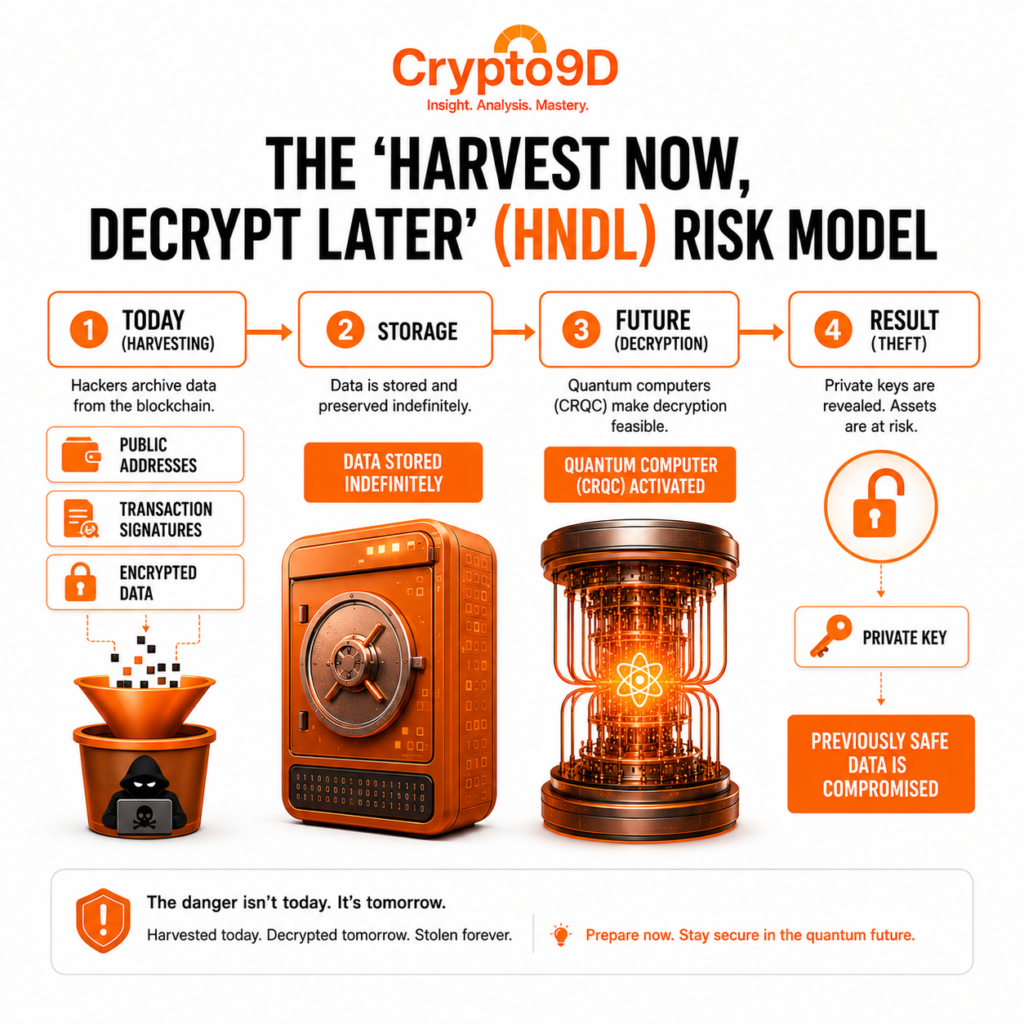
The most realistic quantum threat isn’t instant theft but it’s patience.
Attackers can already:
- Record public keys from blockchain transactions
- Archive signatures indefinitely
- Store encrypted data waiting for future breakthroughs
This is known as harvest now, decrypted later.
For Web3, that means:
- Wallets that reuse addresses
- Contracts with immutable keys
- On-chain identities with permanent signatures
Even if quantum computers capable of breaking elliptic curve cryptography arrive years from now, today’s on-chain data doesn’t disappear.
That’s why post-quantum security isn’t just a future problem. It’s a design problem.
Why Seed Phrases Alone Aren’t Enough Anymore
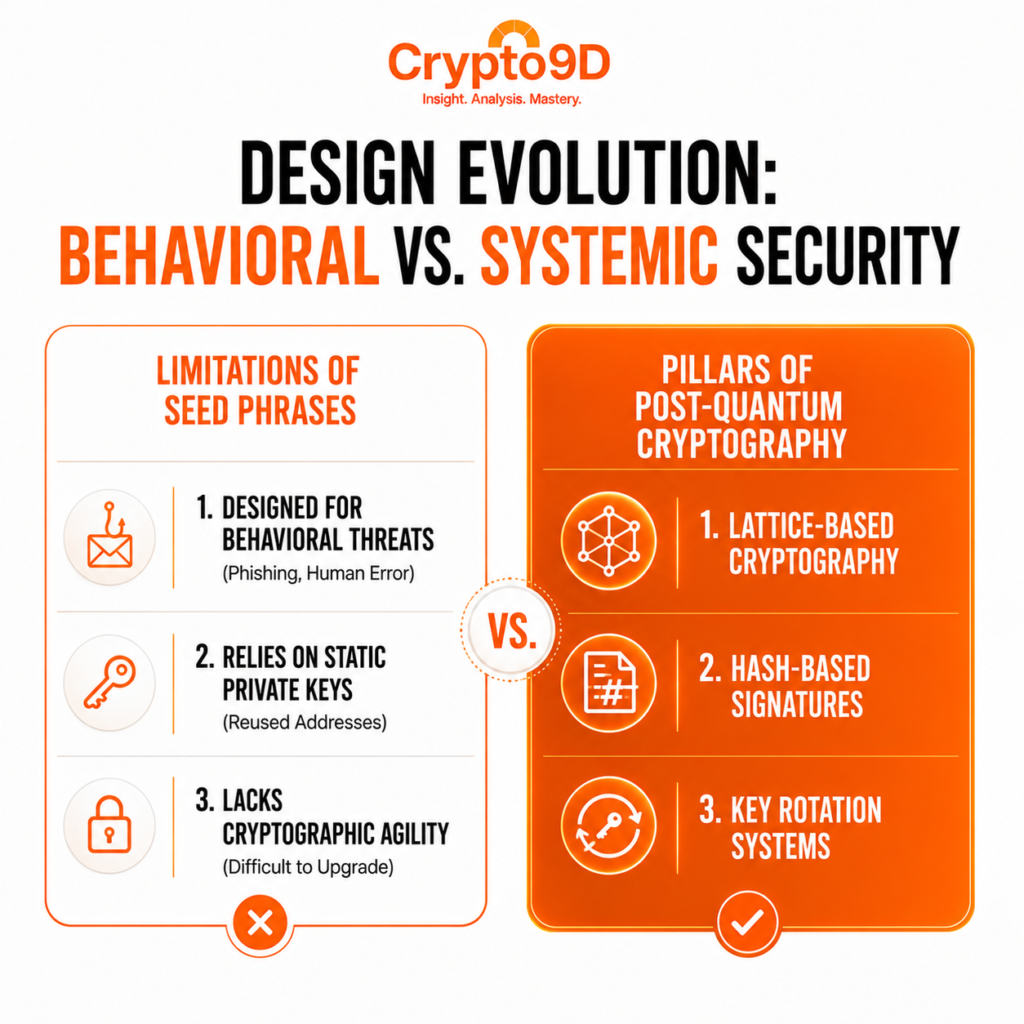
Seed phrases were designed for a simpler threat model:
- Human error
- Phishing
- Malware
- Physical theft
Quantum risk introduces a systemic cryptographic threat, not a behavioral one.
This forces a shift in how Web3 thinks about key management:
- Static private keys become liabilities
- Long-term address reuse becomes dangerous
- “Set and forget” cold storage isn’t future-proof
In other words, the weakest point isn’t the seed phrase itself, it’s the cryptography behind it.
What Is Post-Quantum Encryption?
“Post-quantum cryptography refers to encryption methods designed to remain secure even against quantum computers”.
These algorithms don’t rely on math problems quantum machines can easily solve. Instead, they use:
- Lattice-based cryptography
- Hash-based signatures
- Multivariate polynomial systems
- Code-based encryption
Governments, banks, and cloud providers are already testing post-quantum standards. Web3 is behind not because it’s careless, but because decentralized systems are harder to upgrade.
Blockchains don’t patch like servers. Immutability cuts both ways.
The Web3 Upgrade Challenge
Migrating to post-quantum encryption in Web3 isn’t simple.
Challenges include:
- Backward compatibility with existing wallets
- Upgrading smart contracts that can’t be changed
- Coordinating network-wide cryptographic transitions
- Avoiding fragmentation across chains
Unlike Web2, there’s no central authority to “flip the switch.”
This is why preparation matters more than speed.
Account Abstraction: A Quiet Security Upgrade
One of the most important developments in this context is account abstraction.
Instead of wallets being tied to a single private key, account abstraction allows:
- Programmable authentication
- Key rotation without changing addresses
- Multi-signature logic
- Time-based or conditional approvals
This opens the door to post-quantum readiness without forcing users to abandon existing wallets overnight.
In a post-quantum world, accounts won’t rely on one cryptographic assumption, they’ll evolve.
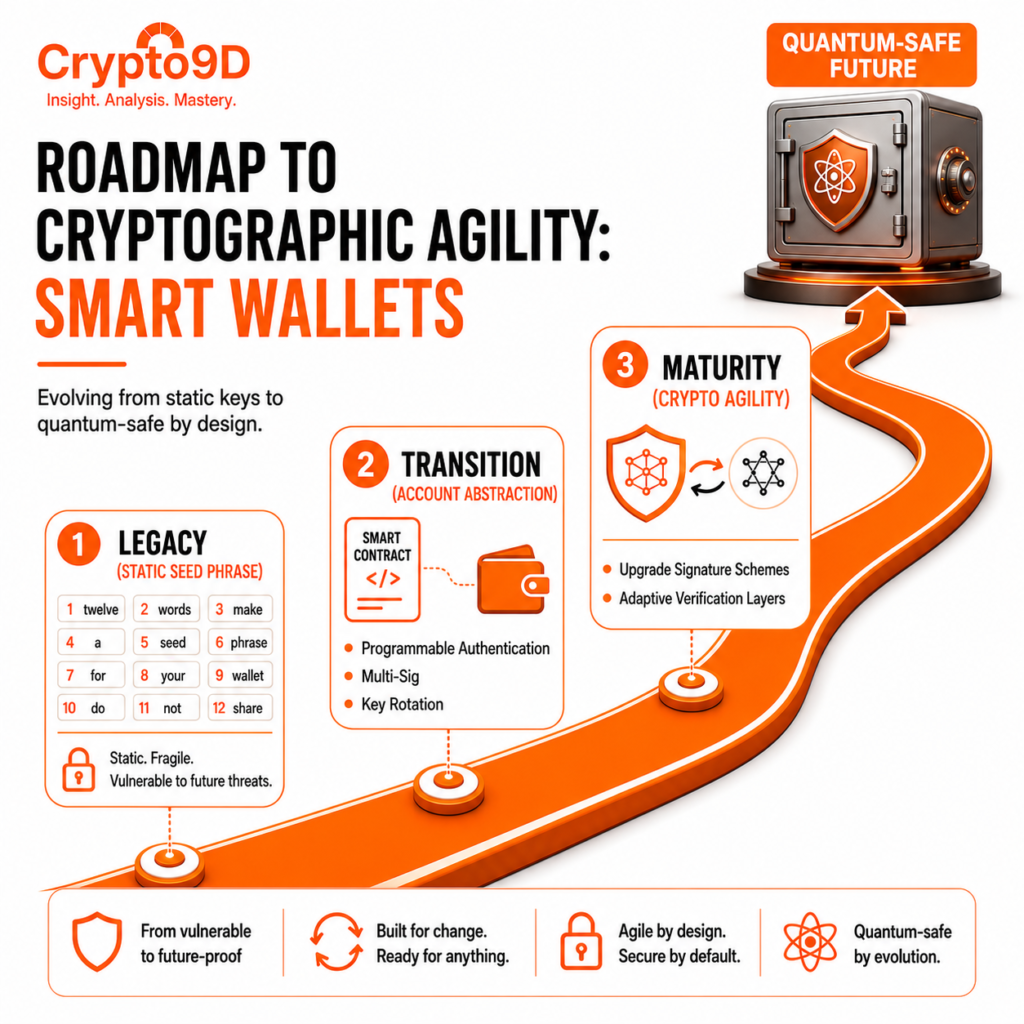
Smart Wallets and Cryptographic Agility
The future of wallet security is cryptographic agility.
That means systems designed to:
- Swap signature schemes
- Add post-quantum verification layers
- Rotate keys automatically
- Combine classical and quantum-resistant methods
Instead of asking, “Is my seed phrase safe forever?”
The better question becomes, “Can my wallet adapt?”
Smart wallets, multi-sig treasuries, and programmable access controls are already pointing in this direction.
What Users Can Do Today
You don’t need a quantum computer on your desk to prepare.
Practical steps include:
- Avoiding address reuse where possible
- Using modern smart wallets instead of legacy EOAs
- Favoring wallets that support key rotation
- Following post-quantum research from major chains
- Staying alert to protocol-level upgrade paths
Security in Web3 has always been layered. Post-quantum encryption is simply the next layer.
What Builders and Protocols Must Think About Now
For developers, the stakes are higher.
Protocols built today will still exist when quantum threats become real. That means:
- Designing upgradeable cryptographic components
- Avoiding hard-coding signature assumptions
- Supporting multi-algorithm verification
- Planning governance paths for security upgrades
The protocols that survive the quantum transition won’t be the ones that move fastest, they’ll be the ones that planned earliest.
This Isn’t Fear. It’s maturity.
Every major technological shift forces a security reckoning.
The internet faced it with HTTPS.
Cloud computing faced it with zero-trust architecture.
Web3 is facing it with post-quantum encryption.
Seed phrases aren’t “broken.”
They’re just no longer the end of the security conversation.
In a post-quantum world, trust won’t come from twelve words written on paper but it will come from systems designed to evolve.
User Case
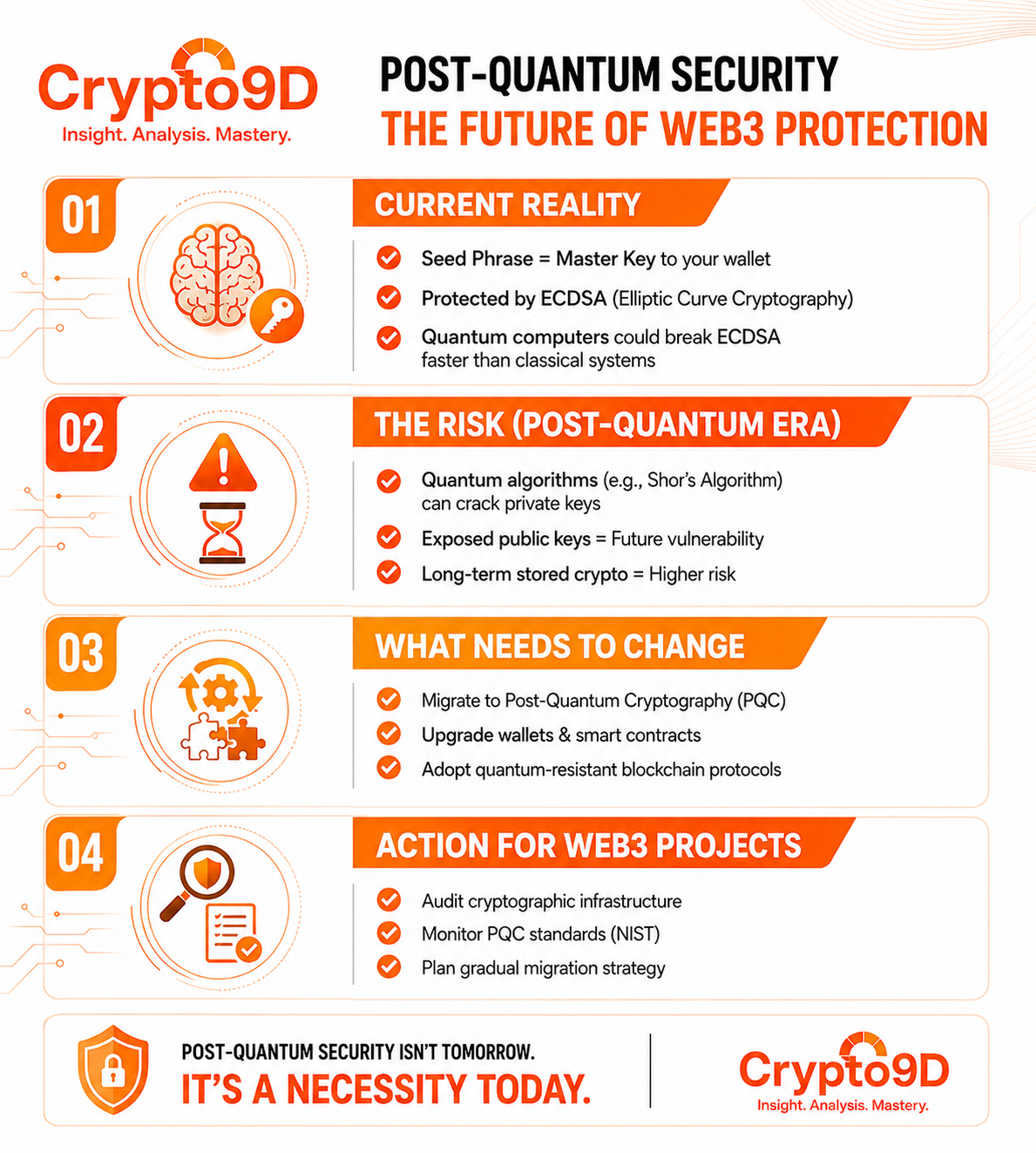
Conclusion
If Web3 is serious about becoming global financial infrastructure, it must think in decades, not cycles.
Post-quantum encryption isn’t a headline.
It’s a responsibility.
The question isn’t whether quantum computing will matter.
The real question is:
When it does, will your wallet still be ready?
As cryptographic assumptions evolve, protocols need infrastructure that can evolve with them. Crypto9D supports upgradeable security models, key rotation, and future-proof wallet architecture designed for long-lived Web3 applications.
See how Crypto9D supports next-generation wallet security.
Frequently Asked Questions
Yes, seed phrases are currently safe because quantum computers capable of breaking elliptic curve cryptography do not yet exist. However the real concern is the "Harvest Now, Decrypt Later" (HNDL) threat where attackers are already recording public keys and blockchain signatures today to decrypt them once a Cryptographically Relevant Quantum Computer (CRQC) becomes available. This makes post-quantum preparation a design problem today, not just a future concern.
Post-quantum cryptography (PQC) refers to encryption methods designed to remain secure even against quantum computers running algorithms like Shor's Algorithm. Instead of relying on math problems quantum machines can easily solve, post-quantum encryption uses lattice-based cryptography, hash-based signatures, multivariate polynomial systems, and code-based encryption. These quantum-safe approaches protect wallet ownership, transaction signing, and smart contract permissions even in a post-quantum world.
Harvest Now, Decrypt Later (HNDL) is the most realistic near-term quantum threat to Web3 security. Attackers are already collecting and archiving public keys, on-chain signatures, and blockchain transaction data today. When a sufficiently powerful quantum computer eventually arrives, this stored data becomes vulnerable to decryption. Wallets that reuse addresses, immutable smart contracts with permanent signatures, and long-lived cold storage wallets holding large balances face the highest exposure to this threat.
Account abstraction is a critical step toward quantum-safe wallet architecture because it removes the dependency on a single static private key. Instead of wallets being permanently tied to one cryptographic assumption, account abstraction enables programmable authentication, key rotation without changing wallet addresses, multi-signature logic, and hybrid signature schemes that combine classical and quantum-resistant methods. This cryptographic agility means wallets can evolve their security model as post-quantum standards develop without forcing users to abandon existing addresses.
Users can prepare by avoiding address reuse to reduce exposure to the Harvest Now Decrypt Later attack vector, switching from legacy externally owned accounts to modern smart wallets that support key rotation, and following post-quantum cryptography research from major blockchain protocols. Builders and protocol developers must design upgradeable cryptographic components, avoid hard-coding signature assumptions, support multi-algorithm verification, and establish governance paths for quantum-safe security upgrades. The protocols and wallets that will survive the Q-Day countdown are those building crypto agility into their architecture today rather than waiting for the threat to become urgent.
Check Out Our Related Services
Ready to apply what you've learned about Bitcoin? Crypto9D offers expert services to help you navigate the crypto world with confidence:
Crypto Analysis
Get comprehensive analysis – fundamental, quantitative, qualitative, and on-chain – to make informed investment decisions.
Tokenomics Design
Get comprehensive analysis – fundamental, quantitative, qualitative, and on-chain – to make informed investment decisions.
Regulatory Compliance
Navigate complex Web3 regulations and ensure your project operates legally across all jurisdictions.
Crypto Education
Master crypto concepts with bespoke training programs tailored to your experience level.
Related Articles:
Top 10 Promising AI, DePIN & RWA Projects – with High Growth Potential for 2026
Bybit Exchange Review 2026 – Institutional Power for Everyone
- Master the art of crypto scalping in 2026 – See how crypto scalping works
What Is Copy Trading? – How It Works
What Is Bitcoin and How Was It Created? – Bitcoin is the world’s first decentralized digital currency
What Are Crypto Wallets – How They Protect Your Funds
Liquidity in Crypto Trading – What It Means and Why It Matters
What Are ETFs – and How Are They Transforming the Way People Invest?
Top 5 Safest Crypto Exchanges – for Beginners:2026 Comprehensive Guide